
Preferred IWB Holster Ride Heights & Cant Angles
Posted by Dana on Nov 29, 2016
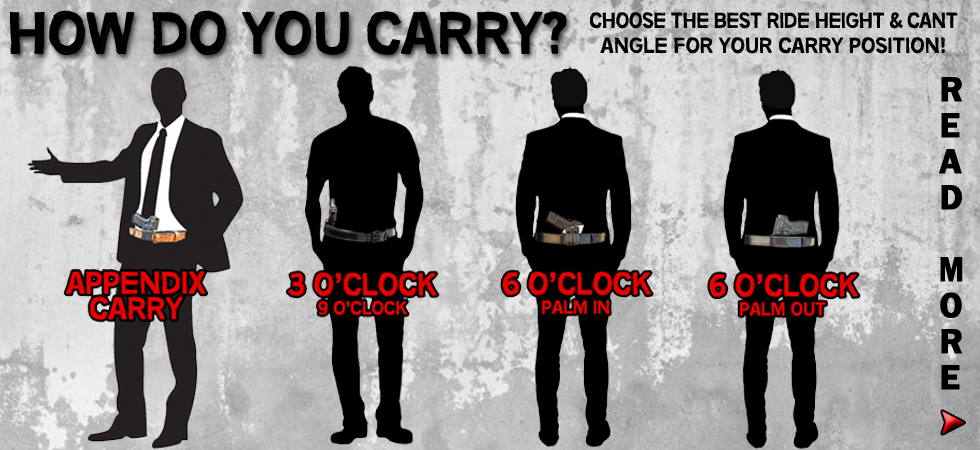
Recommended Specs According to Carry Position
Choosing the Best Concealed Carry Position
The best concealed carry position depends on your body type, firearm, clothing, daily routine, and personal comfort. Ride height and cant angle also play a major role in how well the firearm conceals and how easily you can establish a secure grip.
Below is a practical guide to the most common concealed carry positions and the holster setup generally recommended for each.
Appendix Carry
Appendix carry is worn at the front of the body, typically between the 11 o’clock and 1 o’clock positions. The most common placement is near 12 o’clock.
Holsters designed specifically for appendix carry usually have a slim profile and may include a wedge or similar concealment feature that helps push the grip closer to the body. This can reduce printing, especially with larger handguns or longer grips.
For most appendix-carry setups, we recommend:
Ride height: Mid ride
Cant angle: Straight draw
A mid ride provides enough access to establish a secure grip without positioning the firearm unnecessarily high above the waistband. A straight cant also keeps the firearm aligned naturally at the front of the body.
Strong-Side or Hip Carry
Strong-side hip carry is one of the most common concealed carry positions. For a right-handed carrier, the holster is typically worn between the 3 o’clock and 4 o’clock positions. A left-handed carrier will usually wear it between 8 o’clock and 9 o’clock.
Both IWB and concealable OWB holsters can work well in this position. Light-bearing IWB holsters are available for firearms equipped with a weapon-mounted light, while tuckable holsters allow a shirt to be tucked between the firearm and the belt attachment.
For most strong-side carry setups, we recommend:
Ride height: Mid ride
Cant angle: 7.5-degree forward cant
The slight forward cant angles the grip toward the draw hand, making it easier to access while also helping the grip follow the natural line of the body.
Small-of-Back Carry: Palm-In Draw
Small-of-back carry is generally positioned around 6 o’clock, although some carriers move the holster slightly toward the 5:30 position.
As the holster moves farther behind the hip, a greater forward cant is usually needed to keep the grip accessible. A setup that works well at the hip may become difficult to reach when moved toward the center of the back.
For a palm-in small-of-back draw, the recommended setup is:
Ride height: Mid ride
Cant angle: 15-degree forward cant
Small-of-back carry is generally discouraged because landing on the firearm during a fall could increase the risk of a back or spinal injury. It may also be more difficult to access the firearm while seated or while defending against an attempted gun grab.
Small-of-Back Carry: Palm-Out Draw
A palm-out small-of-back draw places the hand in a different orientation and normally requires a reverse cant.
For this setup, the recommended configuration is:
Ride height: High ride
Cant angle: 15-degree reverse cant
A high ride is important because the reverse cant can otherwise position the grip too deeply below the waistband. A low ride should generally be avoided with this setup, and even a mid ride may make the grip difficult to access.
When ordering, select your normal shooting-hand orientation. A right-handed carrier should order a right-handed holster rather than selecting a left-handed model to compensate for the palm-out draw. The cant and holster configuration should be designed specifically for this carry method.
Palm-out small-of-back carry is strongly discouraged because the draw can cause the muzzle to sweep across the body. It should only be considered when physical limitations prevent the use of a safer and more conventional carry position.
How to Choose the Right Carry Position
There is no single concealed carry position that works best for everyone. Test several positions with an unloaded firearm and focus on four factors:
- Can you establish a complete grip?
- Does the firearm remain concealed during normal movement?
- Is the holster comfortable while standing, walking, and sitting?
- Can you draw without sweeping your body or clothing?
Appendix carry and strong-side hip carry are usually the most practical starting points. Both provide good access, effective concealment, and multiple holster options. Whichever position you choose, use a rigid, firearm-specific holster that completely covers the trigger guard and remains securely attached to your belt.