
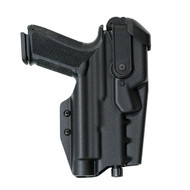
Level 3 Duty Holster Retention Hoods | D3 Manual Override
Posted by Dana Dara on Nov 03, 2026
Spring-Loaded vs. Manual Retention Hoods: Why the D3 Uses Both
When comparing Level 3 duty holsters, most people look at retention levels, draw speed and how the release controls feel. But there's another detail worth looking at: what happens when the retention hood doesn't open the way it's supposed to?
A spring-loaded hood and a manually operated hood handle that problem differently. Both have advantages, and both have limitations. During development of the Dara D3 Level 3 Duty Holster, we decided there was a good reason to combine them.
Spring-Loaded vs. Manual Retention Hoods
Most Level 3 duty holsters use a retention hood that must be moved out of the way during the draw. How that hood moves depends on the design.
Spring-Loaded Retention Hoods
With a spring-loaded hood, pressing the release disengages the lock. Spring tension then rotates the hood forward.
The benefit is simple. The hood moves automatically, without requiring the user to push it through its entire range of motion. That gives the user a quick, consistent release under normal conditions.
The limitation is the amount of force available. The spring can only apply so much torque. If clothing, equipment or another obstruction interferes with the hood, spring tension alone may not be enough to move it completely forward.
Manually Operated Retention Hoods
A manual hood works differently. Instead of relying on spring tension to complete the movement, the user physically drives the hood forward.
That allows the user to apply additional force when the hood meets resistance. The tradeoff is that the user must complete the movement manually, rather than relying on a fast, tactile release.
Neither approach is without compromise. The question is which to choose?
How the D3 Manual Override Works
The D3 Level 3 Duty Holster uses a spring-loaded Rapid-Deploy Hood with an integrated manual override.
Under normal conditions, pressing the strike pad releases the hood lock. Spring tension rotates the hood forward automatically, just as you'd expect from a sprung retention hood.
But if the hood encounters resistance, the user can continue applying pressure to that same strike pad. That additional pressure mechanically drives the hood forward instead of depending on the spring to finish the movement.
There's no separate override button, secondary lever or alternate release sequence. Both functions are built into the same control.
Why Does Manual Override Matter?
Retention systems are easy to evaluate when everything is clean, clear and working under ideal conditions. The more useful question is how the mechanism behaves when something interferes with normal operation.
A retention hood can encounter resistance from clothing, surrounding equipment or external contact. With a spring only system, the spring supplies the force needed to move the hood. If that force isn't enough, the hood may stop before reaching its fully open position, hindering the draw.
The D3 gives the user another way to complete that movement. Continued pressure on the strike pad transfers additional mechanical force to the hood.
It means the user isn't limited to spring tension alone.
For anyone evaluating duty equipment, that's a meaningful mechanical difference.
One Strike Pad, Two Functions
Adding a manual override would be less useful if it required another control or a different hand movement.
On the D3, the override follows the same motion used to release the hood. Initial pressure releases the lock and allows the spring to move the hood forward. Continued pressure drives the hood manually when additional force is needed.
The control placement also supports a proper firing grip. Rather than reaching for a separate override, the user operates the same strike pad as part of the normal release sequence.
This is an important distinction when comparing retention systems. The D3 adds a second method of hood movement without adding a separate step to the draw.
What to Look for When Comparing Level 3 Duty Holsters
Retention level is important, but it doesn't tell you everything about how a holster operates. Two Level 3 holsters can use very different mechanisms and release sequences.
When comparing systems, pay attention to a few specific details:
- Hood operation: Does the hood open automatically, require manual movement or provide both options?
- Obstruction response: What happens when the hood encounters resistance during release?
- Control placement: Can the release controls be operated while establishing a proper firing grip?
- Release sequence: How many separate actions are required to disengage the retention mechanisms?
- Mechanical feedback: Can the user feel when the controls have been engaged and the hood has released?
These are details worth examining, especially for anyone selecting equipment for patrol, security, or other professional applications.
Why We Built It This Way
The D3 was developed with input from law enforcement, military personnel, instructors and experienced end users. Throughout development, we looked at how the retention controls operate, how they interact with the user's grip, and what happens when normal movement is interrupted.
The manual override came from a straightforward design decision: a spring-loaded hood offers a fast, consistent release, while a manual hood gives the user more force when it's needed. We wanted both without adding additional movements to the draw.
The result is a sprung hood that opens automatically under normal conditions and can be driven forward manually through the same strike pad.
Watch Jon Dara demonstrate the D3 Manual Override in the video above.
The Dara D3 Level 3 Duty Holster is scheduled to launch in January 2027. Follow Dara Holsters for additional technical demonstrations and product updates as we get closer to release.