
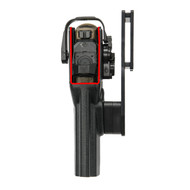
Optic-Ready Holsters: The Complete Guide to Holsters for Red Dot Pistols
Posted by Dana Dara on Oct 06, 2026
Red dot sights are now common on concealed carry pistols, range guns and duty weapons. But adding an optic changes the overall shape of your handgun, which leads to an important question:
Do you need an optic-ready holster for a pistol with a red dot?
In most cases, yes.
An optic-ready holster has extra clearance around the rear of the slide so the red dot does not hit the holster. The pistol should be able to fully seat, retain and draw normally without the optic interfering with the holster.
At Dara Holsters we do offer competition style holsters that have an ejection port cut out and don't specify compatibility with optics. See below:
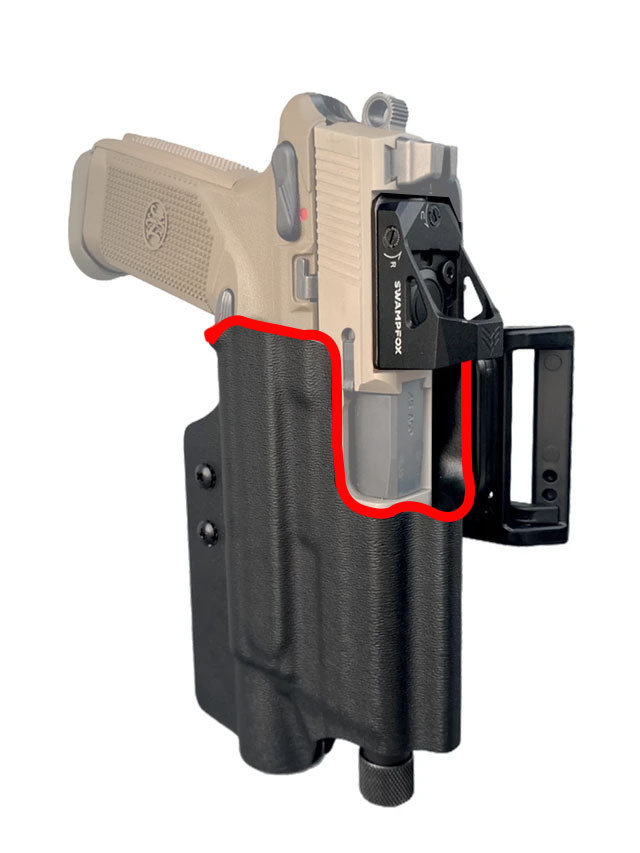
However, "optic ready" does not mean every optic will fit every holster.
The size of the optic matters. Its position on the slide matters. The height of your iron sights can matter. If you're using a duty holster, the retention system and optic protection can matter too.
Here's what you need to know before choosing a holster for a pistol with a red dot.
What Is an Optic-Ready Holster?
An optic-ready holster is a holster designed to provide clearance for a slide-mounted pistol optic.
You may also see these called:
-
red dot holsters
-
RDS holsters
-
optic-cut holsters
-
red dot compatible holsters
They generally mean the same thing.
The holster is cut lower around the area where the optic sits. This gives the red dot enough room to enter and exit the holster without hitting the holster body.
A properly designed optic-ready holster should allow the handgun to:
-
fully seat in the holster;
-
engage the holster's retention;
-
draw without the optic hitting the holster;
-
reholster without interference; and
-
clear the holster's sight channel.
That last point is important.
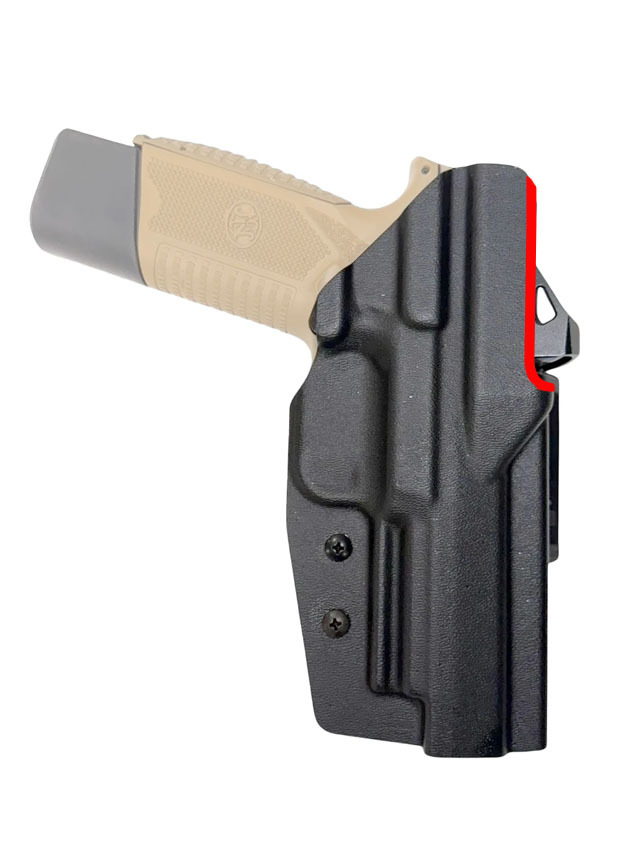
Many pistols with red dots also use suppressor-height or co-witness iron sights. These sights are taller than standard pistol sights.
So an optic-equipped pistol may need both an optic cut and a taller sight channel.
Do I Need a Special Holster for a Red Dot?
Usually.
If your current holster wasn't designed for a pistol-mounted optic, don't assume your gun will still fit after adding a red dot.
This is especially common with older holsters made before pistol optics became as popular as they are today.
A red dot adds material above the rear of the slide. If the holster extends into that area, the optic can hit the holster before the gun is fully seated.
That can affect:
-
fit;
-
retention;
-
drawing;
-
reholstering; and
-
how far the pistol sits inside the holster.
Some older holsters happen to have enough clearance for certain optics. That doesn't make every traditional holster optic compatible.
If you're carrying a pistol with a red dot, use a holster that is designed and confirmed for an optic-equipped handgun.
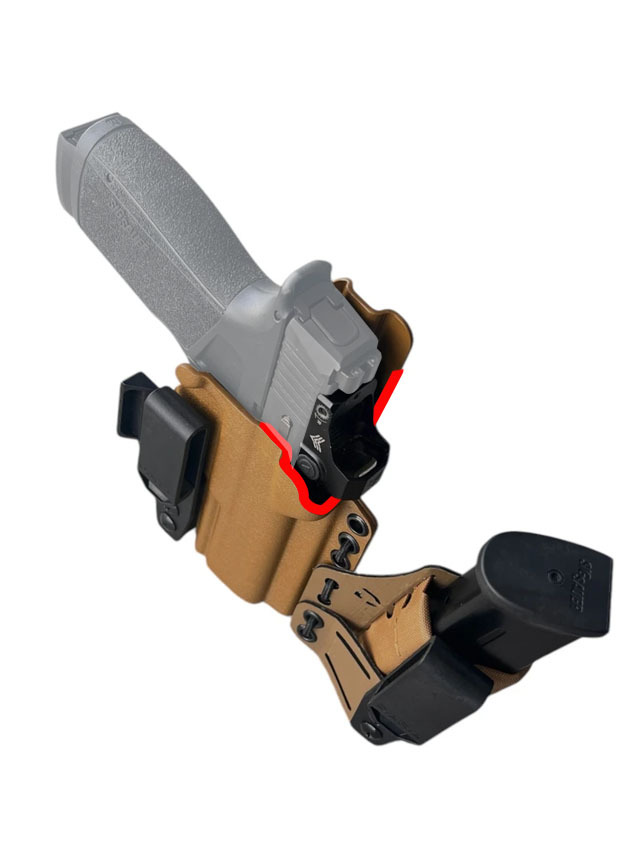
Are All Optic-Ready Holsters the Same?
No.
"Optic ready" is not a universal size or standard.
One manufacturer's optic cut may be different from another manufacturer's.
The optics themselves are different too.
Two red dots mounted on the same pistol can have different heights, widths and lengths. They may also sit in different positions on the slide.
That's why one red dot can fit a particular optic-ready holster while another red dot on the same gun may not.
What Determines Whether a Red Dot Fits a Holster?
There are five main things to look at.
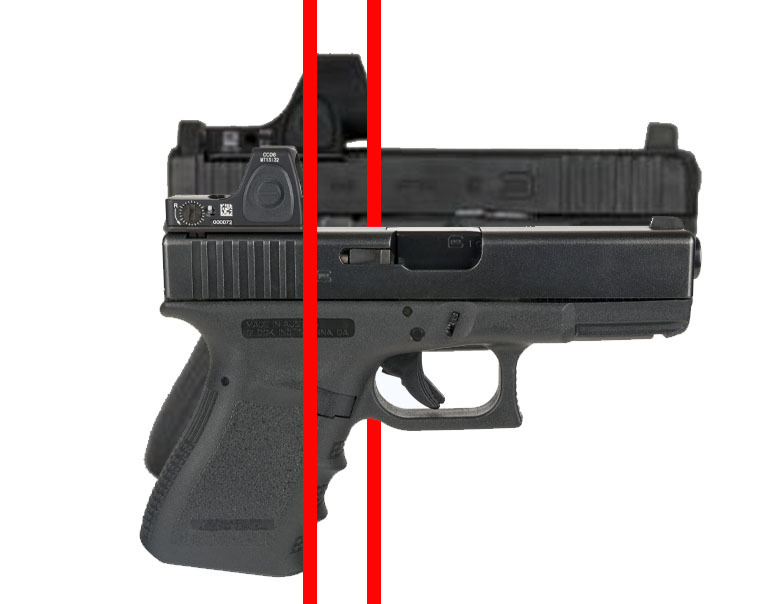
1. Where the Optic Sits on the Slide
Optic position is one of the biggest factors in holster compatibility.
Different pistols use different optic mounting systems. Some optics mount directly to the slide. Others use an adapter plate.
That can change where the optic sits.
The optic itself can also make a difference. Some red dots extend farther toward the front of the slide than others.
If the front of the optic extends into an area occupied by the holster body, the optic can hit the holster even if there is plenty of clearance above it.
At Dara Holsters, most supported slide-mounted optics work with our standard optic cut. However, some forward-projecting optics, including configurations using the Trijicon SRO and RMR HD, may require our deeper optic cut.
So don't look at optic height alone.
Where the optic sits on the pistol matters just as much.
2. Optic Height
Taller optics need more vertical clearance.
This is especially important with duty holsters.
A standard IWB or OWB holster may simply be open around the optic. A duty holster may have a rotating hood, optic shroud or another retention component above the slide.
That means a tall optic may physically fit the holster body but interfere with another part of the duty holster.
Always check the manufacturer's optic-height requirements for a duty holster.
3. Optic Length
Some optics extend farther forward than others.
That can place the front of the optic over an area that would normally be occupied by the holster.
This is why two optics that are nearly identical in height can still require different optic cuts.
The Trijicon RMR and Trijicon SRO are a good example. The SRO extends farther forward, so it may need more clearance even though both are pistol-mounted red dot sights.
4. Optic Width
Width can also affect fit.
This is especially important when the sides of the holster or an optic-protection system sit close to the optic.
The optic needs enough room to move into and out of the holster without rubbing, binding or changing how the pistol sits.
This can become more noticeable with larger enclosed-emitter optics, which have a complete housing around the emitter and lenses.
5. Iron Sight Height
Don't forget about your iron sights.
Many red-dot-equipped pistols use co-witness or suppressor-height sights. These are taller than standard pistol sights.
Your optic may have plenty of room while your front sight does not.
If the front sight is taller than the holster's sight channel, it can drag against the holster or prevent the pistol from seating properly.
That's why optic compatibility should include both:
Optic clearance + sight clearance.
Dara's current OWB and light-bearing OWB holsters use a .5-inch sight channel to accommodate supported suppressor-height and co-witness sights up to that height.
What Is an Optic Cut on a Holster?
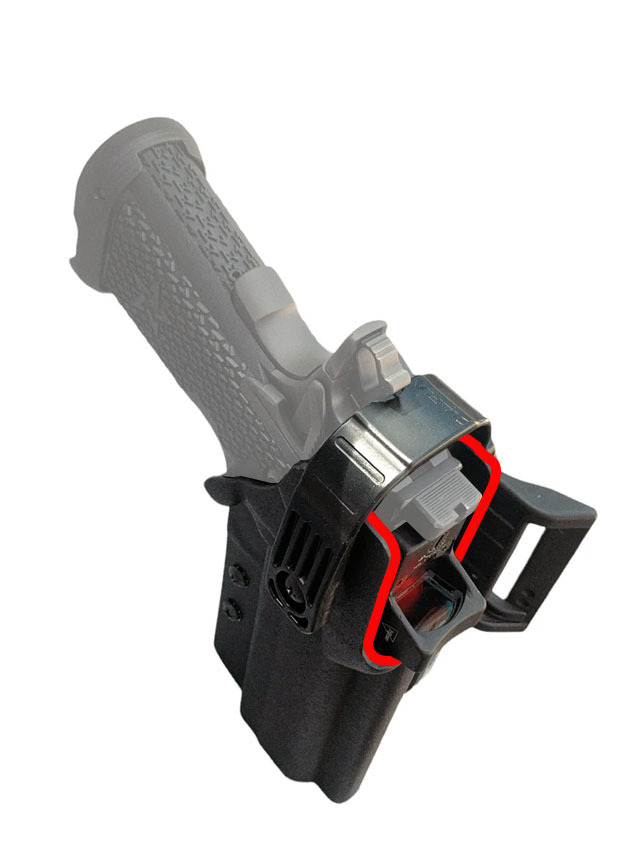
An optic cut is simply the open or relieved area of the holster that provides room for a pistol-mounted red dot.
Don't confuse this with the optic cut on the pistol itself.
On a pistol:
Optic cut = the mounting area machined into the slide for the red dot.
On a holster:
Optic cut = the clearance in the holster body that makes room for the red dot.
They are two different things.
Standard Optic Cut vs. Deeper Optic Cut
Most common pistol red dots will work with a standard optic cut when the optic sits far enough toward the rear of the slide.
Some optics extend farther forward.
Those setups may need the holster's optic cut to extend farther forward as well.
Dara offers a deeper optic cut on applicable holsters for configurations that need this additional clearance.
If your optic extends farther forward than a traditional pistol red dot, check compatibility instead of assuming a standard optic cut will work.
Will a Trijicon RMR Fit an Optic-Ready Holster?
In many cases, yes.
The Trijicon RMR is one of the most common pistol-mounted red dots, and many modern optic-ready holsters provide enough clearance for optics in this general size range.
However, don't confuse an RMR footprint with holster compatibility.
The RMR footprint describes how an optic mounts to the pistol.
It does not tell you the complete outside dimensions of the optic.
Two optics can use the same mounting footprint and still have different housing sizes and shapes.
Will a Trijicon SRO Fit an Optic-Ready Holster?
Not always.
The Trijicon SRO extends farther forward than many traditional pistol red dots.
That extra length can cause the front of the SRO to hit a holster that has plenty of room for a standard RMR.
Dara offers a deeper optic cut on applicable holsters to provide additional clearance for these configurations.
This is a perfect example of why "optic ready" doesn't automatically mean "fits every optic."
Will a Trijicon RMR HD Fit an Optic-Ready Holster?
It depends on the holster.
The Trijicon RMR HD also extends farther forward than a traditional RMR.
Because of that additional forward projection, some pistol and holster combinations need more clearance.
For applicable Dara holsters, select the deeper optic cut when your configuration requires it.
Do Enclosed-Emitter Optics Need a Different Holster?
Not necessarily.
An open-emitter optic has an exposed emitter. An enclosed-emitter optic places the emitter inside a closed housing.
The Aimpoint ACRO is a well-known example of an enclosed-emitter pistol optic.
Because an enclosed optic has a complete housing, it may be taller, wider or longer than another red dot.
But the fact that an optic is enclosed doesn't automatically make it incompatible with an optic-ready holster.
What matters is its actual:
-
height;
-
width;
-
length; and
-
position on the pistol.
An enclosed-emitter optic can fit an optic-ready holster as long as the holster provides enough clearance for that specific setup.
Do Suppressor-Height Sights Require a Special Holster?
They require a holster with a tall enough sight channel.
Suppressor-height sights are taller than normal pistol sights.
If your front sight is taller than the holster's sight channel, it may drag against the holster during the draw or prevent the gun from fully seating.
This can happen even when there is plenty of room for the red dot itself.
When checking holster compatibility, look at both the optic cut and sight-channel height.
Dara holsters with a .5-inch sight channel can accommodate supported sights up to that height.
What Are Co-Witness Sights?
Co-witness sights are taller iron sights that remain visible through or in relation to the window of a pistol-mounted red dot.
Different shooters use different sight heights depending on how much of the iron sights they want visible through the optic.
For holster fit, the important part is simple:
The holster's sight channel needs to be taller than your sights.
Can I Use an Optic-Ready Holster Without a Red Dot?
Yes.
An optic cut simply removes material from an area of the holster where a red dot would normally sit.
You can still use the holster without an optic installed as long as the holster is made for your firearm configuration.
The optic cut itself isn't what determines firearm retention.
Does a Red Dot Change Holster Retention?
No, not when the holster is designed correctly for the setup.
Holster retention is generally created somewhere else on the firearm or weapon light—not by clamping onto the optic.
The optic cut simply provides clearance.
There is one important exception to keep in mind: if the optic hits the holster and prevents the pistol from fully seating, the gun may never reach the point where the holster's retention engages.
Duty holsters also have active-retention components that need to work properly around the optic.
That's why both optic clearance and retention compatibility matter.
Are IWB Holsters Optic Ready?
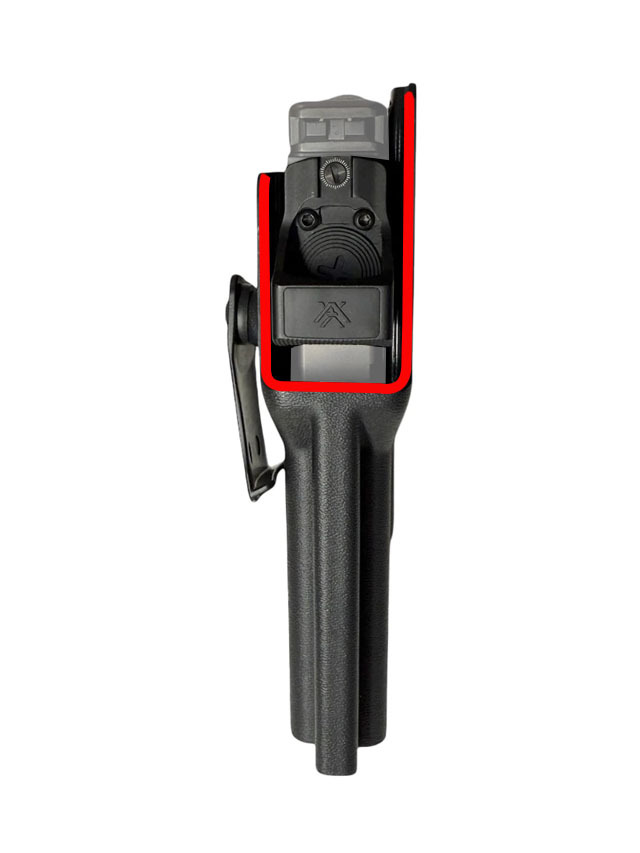
At Dara, yes.
Dara IWB holsters are designed with clearance for a slide-mounted optic.
The same basic compatibility rules still apply. The optic needs enough clearance, and the sight channel needs to be tall enough for your iron sights.
Are Appendix Holsters Optic Ready?
At Dara, yes.
Dara AIWB, or appendix inside-the-waistband, holsters are designed to accommodate supported pistol-mounted optics.
Adding a red dot doesn't change the other things you should consider when choosing an appendix holster, including firearm fit, retention, ride height, cant and attachment setup.
Are OWB Holsters Optic Ready?
At Dara, yes.
Dara's current standard OWB holsters come optic ready. You don't need to purchase a separate "optic-ready" version just because your pistol has a red dot.
They also have a taller sight channel for supported suppressor-height and co-witness sights.
Some forward-projecting optics may still require the deeper optic cut.
Can a Light-Bearing Holster Also Be Optic Ready?
Yes.
A pistol can have all three at the same time:
-
a red dot;
-
tall iron sights; and
-
a weapon-mounted light.
The holster simply needs to be designed around that complete configuration.
Light bearing and optic ready mean two different things.
A light-bearing holster is designed around a firearm and weapon light.
An optic-ready holster provides clearance for a slide-mounted optic.
A holster can be both.
If your pistol has a weapon light and red dot, choose a holster designed for your exact firearm and light combination that also provides the necessary optic clearance.
What About Red Dots on Duty Pistols?
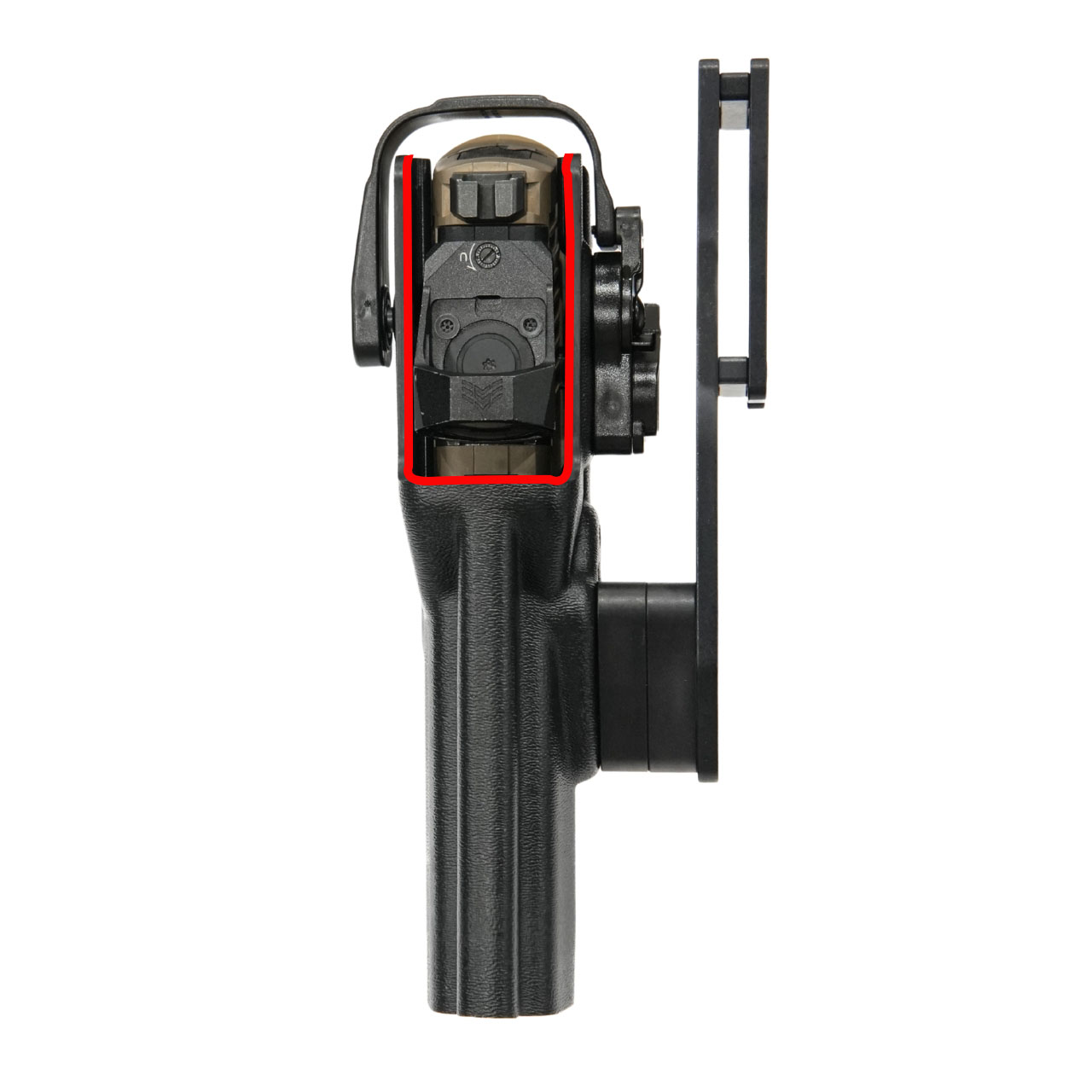
Duty holsters need a little more consideration because they use active-retention systems and may include additional protection around the optic.
At Dara, all Level 2 Duty Holsters are cut to accommodate supported pistol optics.
The optic still needs to work with the holster's rotating retention hood.
That's why optic height matters on a Level 2 Duty Holster.
Dara offers different hood sizes to accommodate different optic heights. To determine which hood you need, measure from the top of the pistol slide to the top of the optic.
If the optic is too tall for the standard hood, you'll need the larger hood option.
Our D3 Level 3 Duty Holster handles optics differently. The optic sits within the holster's protective optic shroud.
That brings us to another important difference.
Optic Ready vs. Optic Protection
An optic-ready holster and an optic-protective holster are not necessarily the same thing.
Optic ready means the holster provides room for the optic.
Optic protection means the holster also places physical structure around or over the optic.
That extra protection can be especially useful on a duty holster.
An officer's holstered pistol can hit vehicle interiors, doors, barriers, desks and other equipment throughout a shift.
A protective optic shroud helps shield the optic from those impacts and from environmental exposure.
When comparing duty holsters, don't just ask whether they fit a red dot.
Ask whether the optic is exposed or protected.
Can I Add a Red Dot to My Gun and Keep My Current Holster?
Maybe.
Before using your existing holster, check four things:
-
Does the holster have enough clearance for an optic?
-
Does the optic cut extend far enough forward for your red dot?
-
Is the sight channel tall enough for your iron sights?
-
Can the pistol fully seat and engage the holster's retention without the optic hitting anything?
If you're unsure about any of these, check with the holster manufacturer.
Don't force an optic-equipped pistol into a holster that wasn't designed for it.
Can You Modify a Holster to Fit a Red Dot?
Technically, thermoplastic holsters can be cut or altered.
That doesn't mean you should do it.
Removing material can affect the holster's structure, fit and finished edges. It can also void the manufacturer's warranty.
Modifying a Dara Holster voids the warranty.
It's better to order the correct optic-compatible holster from the beginning.
There are also some optic mounting configurations that simply won't work with a particular holster design. Cutting more material away isn't always a solution.
If you're unsure about an unusual optic or mounting setup, contact us before modifying the holster.
Does the Optic Footprint Determine Holster Fit?
No.
This causes a lot of confusion.
Terms such as RMR footprint describe the mounting interface between the optic and the pistol.
The footprint does not tell you the complete outside dimensions of the optic.
Two optics using the same or similar footprint can still have different:
-
lengths;
-
heights;
-
widths;
-
housing shapes; and
-
forward projections.
So:
Same optic footprint does not mean same holster fit.
A holster has to clear the actual optic housing—not just the mounting screws underneath it.
Does an Optic Mounting Plate Affect Holster Fit?
It can.
Some optics mount directly to a pistol's slide. Others require an adapter or mounting plate between the slide and optic.
A mounting plate can raise the optic higher above the slide. Depending on the pistol and mounting system, it may also change where the optic sits in relation to the holster.
Direct-Mounted Optic
With a direct-mounted optic, the red dot attaches directly to the pistol's optic cut without a separate adapter plate between the optic and slide.
This generally keeps the optic lower on the pistol.
Plate-Mounted Optic
With a plate-mounted optic, an adapter plate sits between the slide and red dot.
That plate adds height to the complete setup and can sometimes change the optic's position.
This is why telling a holster manufacturer which optic you have isn't always enough.
The same optic can sit differently depending on the pistol and how it is mounted.
Does Optic Height Affect Concealed Carry?
A red dot adds some height and bulk to the rear of the slide, but it doesn't automatically make a pistol difficult to conceal.
The pistol grip is usually a much bigger contributor to printing.
Concealment also depends on:
-
holster position;
-
ride height;
-
cant;
-
belt stiffness;
-
holster attachment;
-
clothing; and
-
body shape.
For most shooters, choosing a properly designed optic-ready concealment holster is more important than avoiding a red dot because of its size.
What Should You Look for in an Optic-Ready Holster?
Before buying a holster for a pistol with a red dot, check the complete setup.
| Feature | What to Check |
|---|---|
| Firearm fit | The holster is made for your specific handgun configuration |
| Optic clearance | The red dot doesn't contact the holster |
| Forward clearance | Longer optics have enough room in front |
| Sight channel | Tall iron sights clear the holster |
| Retention | The pistol fully seats and retention works correctly |
| Weapon-light fit | The holster is made for your firearm/light combination |
| Duty retention | Hoods and other retention parts clear the optic |
| Optic protection | Decide whether your use requires a protective optic shroud |
Instead of only asking:
"Is this holster optic ready?"
Ask:
"Will this holster fit my complete firearm setup?"
That's the question that actually matters.
How Dara Designs Holsters for Optic-Equipped Pistols
At Dara Holsters & Gear, we look at the complete firearm configuration when determining holster fit.
Our holsters are manufactured in Wendell, North Carolina using firearm-specific tooling rather than assuming every pistol in the same family has identical dimensions.
Depending on the firearm and holster, we can accommodate configurations that include:
-
slide-mounted red dot sights;
-
forward-projecting optics using the appropriate deeper cut;
-
suppressor-height and co-witness sights;
-
weapon-mounted lights;
-
threaded barrels and supported extended configurations; and
-
active-retention duty setups.
Our standard OWB and light-bearing OWB holsters come optic ready and use a .5-inch sight channel for supported taller sights.
Our Level 2 Duty Holsters are designed for optic-equipped duty pistols and offer hood options for different optic heights.
Our D3 Level 3 Duty Holster places the supported optic inside a protective optic shroud.
The important thing is to choose a holster for the gun you actually carry.
If you're unsure whether your firearm, optic, sights or weapon light will fit, check compatibility before ordering rather than assuming that "optic ready" means every possible setup will work.
Optic-Ready Holster FAQ
What does optic ready mean on a holster?
An optic-ready holster has clearance for a slide-mounted pistol optic or red dot sight. It may also have a taller sight channel for suppressor-height or co-witness sights.
Is an optic-ready holster the same as a red dot holster?
Generally, yes. Optic-ready holster, red dot holster, RDS holster and optic-cut holster are commonly used to describe holsters designed to accommodate pistol-mounted optics.
Do all red dots fit optic-ready holsters?
No. Red dots have different dimensions and can sit in different positions on the slide. Some larger or farther-forward optics need additional clearance.
Can I use an optic-ready holster without an optic?
Yes. The optic cut simply provides additional clearance. The holster still needs to be made for your firearm configuration.
Will a red dot affect holster retention?
Normally, no. Holster retention is generally created somewhere else on the firearm or weapon light. However, an optic that hits the holster can prevent the pistol from fully seating and engaging the retention system.
Do I need a special holster for suppressor-height sights?
You need a holster with a sight channel tall enough for your sights. Having an optic cut does not automatically mean the holster has enough front-sight clearance.
Will an enclosed-emitter optic fit an optic-ready holster?
It depends on the size and position of the optic and the amount of clearance in the holster. Some enclosed-emitter optics fit standard optic cuts while others may need more room.
Will an Aimpoint ACRO fit an optic-ready holster?
It depends on the firearm and holster. The ACRO has an enclosed housing, so the holster needs enough clearance around the complete optic.
Will a Trijicon SRO fit an optic-ready holster?
Not always. The SRO extends farther forward than many traditional pistol red dots. Dara offers a deeper optic cut on applicable holsters for configurations that need this additional clearance.
Will a Trijicon RMR HD fit an optic-ready holster?
It depends on the firearm and holster. The RMR HD extends farther forward than a traditional RMR, so some setups require additional clearance.
Can a pistol have both a red dot and weapon light in the same holster?
Yes. The holster needs to be designed for the specific firearm and weapon-light combination while also providing enough clearance for the optic and sights.
Are Dara Holsters optic ready?
Dara's current IWB, AIWB and standard OWB holsters are designed to accommodate supported pistol-mounted optics. Dara Level 2 Duty Holsters also accommodate supported optics, while the D3 Level 3 Duty Holster places the optic within its protective optic shroud.
Exact compatibility still depends on the firearm, optic position, sight height, weapon light and holster model.
How do I know if my red dot will fit my Dara Holster?
Start with your exact firearm and holster, then look at your optic's size and position and the height of your iron sights.
If your optic extends unusually far forward, such as certain Trijicon SRO or RMR HD configurations, you may need the deeper optic cut where offered.
For a Level 2 Duty Holster, also check your optic height to determine which retention hood you need.
The Bottom Line: Choose a Holster for Your Complete Setup
Adding a red dot changes the outside dimensions of your pistol.
A good optic-ready holster gives the optic and sights enough room while still allowing the firearm to fully seat, retain and draw correctly.
But remember:
"Optic ready" does not mean "every optic fits."
The optic's position, length, height and width can all matter. Your iron sights can matter. A weapon light can matter. On a duty holster, the retention system and optic protection can matter.
Instead of looking at only the pistol model, think about the complete setup:
Pistol + optic + sights + weapon light, if applicable + holster + retention system.
That's the best way to determine whether a holster will actually fit the firearm you carry.
Dara Holsters & Gear manufactures optic-ready concealed carry, OWB, competition and duty holsters in North Carolina for a wide range of pistol configurations. Choose your exact firearm and applicable accessories when ordering so your holster is configured for the setup you actually use.