
Concealed Carry & IWB Holster FAQ
This FAQ covers common questions about concealed carry holsters, IWB holsters, appendix carry, firearm fitment, weapon lights, optics, retention, ride height, cant, holster materials and choosing the right concealed carry setup.
What is an IWB holster?
IWB stands for Inside the Waistband. An IWB holster is worn inside the waistband of your pants with the holster attachment secured to your belt. Because most of the firearm rides below the waistband, IWB carry is one of the most common methods of concealed carry.
What is the difference between IWB and AIWB carry?
IWB refers to any holster carried inside the waistband. AIWB stands for Appendix Inside the Waistband and refers specifically to carrying toward the front of the body, generally between the centerline and front of the hip.
Both are inside-the-waistband carry methods. The primary difference is where the firearm is positioned on the body.
What makes a good concealed carry holster?
A good concealed carry holster should securely retain the firearm, completely cover the trigger guard, remain securely attached to the belt, maintain its shape when the firearm is removed and allow a consistent draw.
Fit, retention, belt support, concealment and comfort should all be considered when choosing a holster for everyday carry.
Is a firearm-specific holster better than a universal holster?
A firearm-specific holster is molded around the dimensions and retention points of a particular handgun. This allows the holster to provide consistent retention, complete trigger-guard coverage and predictable firearm positioning.
Universal holsters are designed to accommodate multiple firearm models and therefore cannot be molded around one exact firearm in the same way.
Why does exact firearm fit matter in a concealed carry holster?
Even firearms from the same manufacturer or product family can have differences in frame dimensions, trigger guards, slide lengths, controls and accessory rails.
A holster molded for the correct firearm reduces unnecessary movement and allows the retention system to engage the firearm where it was designed to.
How are Dara IWB Holsters made?
Dara IWB Holsters are made to order based on the options selected by the customer. The firearm model, handedness, attachment, color and other available options are selected when the order is placed.
Our holster molds are made by us using the firearm models we support. After forming, each made-to-order holster is fit tested with the appropriate firearm before shipment.
Why are Dara Holsters made to order?
Dara supports hundreds of firearm and configuration combinations. In addition to the firearm itself, an order may vary by handedness, weapon light, color, belt attachment and other product-specific options.
With so many possible combinations, we rarely manufacture the exact same holster configuration twice in a single week. Made-to-order manufacturing allows us to support substantially more firearm configurations than we could if every finished holster had to be kept in inventory.
Where are Dara IWB Holsters made?
Dara Holsters are manufactured in Wendell, North Carolina, USA.
What materials are Dara IWB Holsters made from?
Dara IWB Holsters use rigid thermoplastic holster bodies designed to maintain their shape during everyday use. Depending on the product, Dara uses materials such as Boltaron along with stainless steel hardware and purpose-built retention and attachment components.
What is the difference between Kydex and Boltaron?
Kydex and Boltaron are different brands of rigid thermoplastic sheet material commonly used to manufacture molded holsters. Both can provide the rigidity, moisture resistance and shape retention required for a firearm-specific holster.
You can learn more in our Kydex vs. Boltaron guide.
Why are rigid thermoplastic holsters commonly used for concealed carry?
A rigid thermoplastic holster maintains its shape when the firearm is removed. It can also be molded around a specific firearm to provide defined retention points and complete trigger-guard coverage.
Thermoplastic materials are also resistant to moisture and do not require the same type of break-in process associated with some traditional holster materials.
Do I need to break in a Dara IWB Holster?
No. A properly fit thermoplastic holster should not require a traditional break-in period.
If you prefer more or less draw resistance, Dara IWB Holsters feature adjustable retention that allows the user to fine-tune the draw resistance.
What is adjustable holster retention?
Adjustable retention allows you to change the amount of resistance experienced when drawing the firearm from the holster.
On Dara IWB Holsters, tightening the retention hardware increases resistance while loosening it reduces resistance.
How do I adjust the retention on a Dara IWB Holster?
Use a Phillips-head screwdriver to adjust the retention screws in small increments. Quarter-turn adjustments make it easier to fine-tune the draw resistance without making a large change at once.
Tightening the screws increases retention. Loosening them decreases retention.
How tight should an IWB holster be?
The holster should retain the firearm securely while still allowing a controlled and consistent draw. It should not be so loose that the firearm moves excessively inside the holster or comes out unintentionally.
Personal preference can affect the desired draw resistance, which is why adjustable retention is useful.
Should my firearm click into the holster?
Many firearm-specific thermoplastic holsters produce an audible or tactile click as the firearm passes through the retention point. The amount of sound varies depending on the firearm and holster design.
Light-bearing holsters often retain the firearm differently than non-light-bearing holsters, so the sound may be less noticeable. The presence or volume of a click by itself should not be used to determine whether a holster fits correctly.
Does a concealed carry holster need to cover the trigger guard?
Yes. A properly fitted concealed carry holster should completely cover the trigger guard while the firearm is fully seated.
Dara's firearm-specific IWB Holsters are designed around the selected firearm and provide complete trigger-guard coverage.
Are Dara IWB Holsters optics ready?
Yes. Dara IWB Holsters are made with an optic cut designed to accommodate most common pistol-mounted red-dot sights.
Certain forward-mounted or unusually positioned optics may require a deeper optic cut or a specific configuration. Check the individual product options before ordering.
Will a red dot sight fit a Dara IWB Holster?
Most common handgun-mounted red-dot sights are compatible with Dara's optics-ready IWB Holsters.
Deeper optic cuts are available for certain forward-mounted optics, including configurations such as the Trijicon SRO and RMR HD.
Will suppressor-height sights fit?
Dara IWB Holsters have a raised sight channel designed to accommodate suppressor-height sights measuring up to .5 inches tall.
Can I use a threaded barrel with a Dara IWB Holster?
Dara IWB Holsters use an open muzzle design that can accommodate most threaded barrels, provided the rest of the firearm configuration matches the holster.
Do aftermarket firearm parts affect holster fit?
They can. Aftermarket slides, compensators, gas pedals, takedown levers, oversized controls, frame modifications and rail-mounted accessories can change the external dimensions of the firearm.
If your firearm has been modified, verify compatibility before ordering. A holster made for a factory firearm should not automatically be assumed to accommodate aftermarket modifications.
Do you make light-bearing IWB holsters?
Yes. Dara manufactures light-bearing IWB and concealed carry holsters for many supported firearm and weapon-light combinations.
Browse our IWB Holster collection or select the Light Bearing IWB Holster to see currently available firearm and light combinations.
What is the difference between a standard IWB holster and a light-bearing IWB holster?
A standard IWB holster is molded around the firearm without a weapon-mounted light.
A light-bearing IWB holster is manufactured around a specific firearm and weapon-light combination. Because the light changes the external dimensions and retention geometry of the firearm, light-bearing holsters must be designed specifically for compatible combinations.
Can I use a different weapon light in my light-bearing holster?
Do not assume that another weapon light will fit simply because it mounts to the same firearm. Different lights have different dimensions, shapes and mounting positions.
Select the exact firearm and weapon-light combination listed on the Dara product page when ordering a light-bearing holster.
How do I know if Dara makes a holster for my handgun?
If your exact firearm is available in the firearm dropdown on the product page, Dara currently supports that configuration for that holster.
You can also view our Full Firearms List to see the firearm models currently supported across Dara products.
What if my firearm is not listed?
If your exact firearm or firearm and light combination is not listed, do not select a similar model and assume it will fit.
You can submit the configuration through our Firearm Request Form. Customer requests help us determine which firearms and weapon-light combinations to support next.
How do I choose the correct firearm model when ordering?
Select the exact manufacturer, model, generation and barrel length that match your firearm. If the holster is light bearing, select the exact weapon light as well.
Similar firearm names do not always mean the firearms use the same holster. If you are unsure which option matches your firearm, contact Dara before placing the order.
What is the best position for concealed carry?
There is no single carry position that works best for everyone. Body shape, firearm size, clothing, daily activity and personal preference all affect comfort and concealment.
Appendix carry works well for many people, while others prefer strong-side IWB carry. Trying different positions is often the best way to determine what works for your body and equipment.
What is appendix carry?
Appendix carry, commonly abbreviated AIWB, positions the firearm inside the waistband toward the front of the body.
AIWB holsters are generally designed to keep the firearm close to the body while allowing access to the grip.
Can I carry a Dara IWB Holster on my strong side?
Yes. Dara's standard IWB Holster can be worn for strong-side inside-the-waistband carry.
The exact position can be adjusted around the waistband to find the combination of concealment, comfort and accessibility that works best for the individual user.
How do I reduce printing while carrying concealed?
Printing occurs when the outline of the firearm becomes visible through clothing. Holster position, firearm size, ride height, cant, belt rigidity and clothing can all affect printing.
Moving the holster slightly along the waistband, adjusting the ride height or cant, and using a supportive gun belt can help keep the grip closer to the body.
What is holster ride height?
Ride height determines how high or low the firearm sits relative to the waistband.
The firearm should ride high enough to allow a complete grip while remaining low enough to conceal comfortably. Different body types and carry positions may work better with different ride heights.
What is holster cant?
Cant is the angle at which the firearm sits in the holster.
A neutral or straight cant is commonly used for appendix carry. A forward cant is commonly used for strong-side carry because it can change the angle of the grip and make it easier to reach or conceal.
See our Ride Height and Cant Angle Guide for more information.
Does body type affect concealed carry?
Yes. Waist size, torso length, body shape, clothing and firearm dimensions all affect how a concealed firearm sits against the body.
This is why a holster position or setup that works extremely well for one person may not be the best setup for another.
Do I need a gun belt for an IWB holster?
A rigid belt designed to support the weight of a firearm can improve holster stability and concealment. A supportive belt helps prevent the holster from sagging, twisting or moving excessively during daily activity.
The belt width should also match the holster's belt attachment.
What belt attachments are available for Dara IWB Holsters?
Dara offers several IWB belt attachment options depending on the holster model, including the Curved Clip™(1.5"), Flat Clip (1.75") and soft loops 1.5", 1.75" & 2").
Available attachment options and belt widths are listed on the individual holster product page.
What is a holster sweat shield?
A sweat shield is the raised portion of the holster that extends behind the rear of the slide.
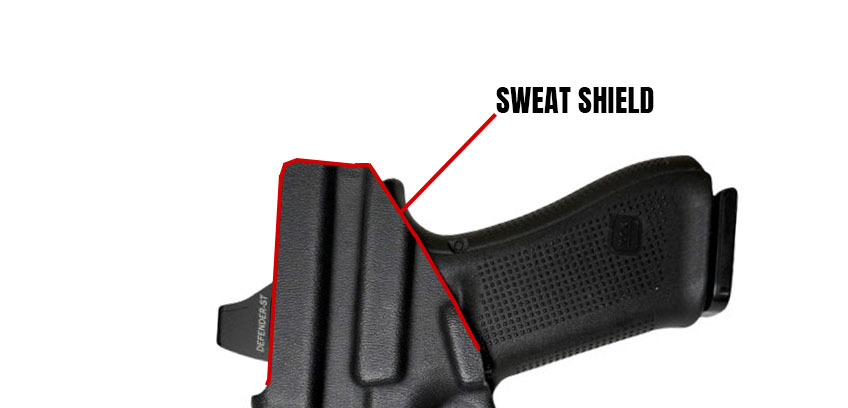
It creates a barrier between the firearm and the body and can help reduce direct contact with sweat. It can also help reduce pinching between the firearm and the body during reholstering.
How should I clean an IWB holster?
Remove the firearm before cleaning the holster. Dirt, lint and debris can be removed with compressed air or a damp cloth.
Allow the holster to dry completely before returning the firearm to it. Regularly inspect the holster, attachment hardware and retention components for damage or loose hardware.
Can heat damage a Kydex or Boltaron holster?
Kydex and Boltaron are thermoformed materials. Excessive heat can soften thermoplastic and potentially change its molded shape.
Avoid intentionally heating the holster or leaving it exposed to extreme heat for extended periods.
What happens if my Dara IWB Holster does not fit?
Dara made-to-order holsters are fit tested with the appropriate firearm and weapon light, when applicable, before shipment.
If the firearm does not seat correctly and the firearm and accessories match the configuration selected when ordering, contact Dara customer service so the fitment issue can be evaluated.
What warranty comes with a Dara IWB Holster?
Dara-manufactured and branded holsters are backed by Dara's Lifetime Guarantee. If a qualifying Dara product becomes damaged or defective, Dara will repair or replace it according to the current warranty policy.
Can I order a left-handed concealed carry holster?
Yes. Dara's made-to-order IWB Holsters are available in both right-handed and left-handed configurations where listed on the product page.
What Dara holster is best for someone who wants multiple concealed carry configurations?
The Dara Concealment System (DCS) is designed for users who want multiple carry configurations from the same holster system.
Depending on configuration, the DCS can be used as a single-clip or dual-clip IWB or AIWB holster, an appendix rig with a detachable magazine carrier, or a concealable OWB holster.
A Light-Bearing DCS System is also available for supported firearm and weapon-light combinations.
What should I look for when choosing an everyday concealed carry holster?
Start with the exact firearm and accessories you plan to carry. Then consider trigger-guard coverage, firearm-specific fit, retention, belt attachment, carry position, ride height, cant, optics compatibility and whether you use a weapon-mounted light.
The best concealed carry setup is one that securely carries the correct firearm, remains stable throughout normal daily activity and allows the user to consistently access the firearm while following safe firearm-handling practices.
Why choose a Dara IWB Holster?
Dara Holsters manufactures firearm-specific concealed carry holsters in Wendell, North Carolina. Our made-to-order IWB Holsters are built around the firearm configuration selected by the customer and are fit tested before shipment.
Dara IWB Holsters combine rigid thermoplastic construction, adjustable retention, optics-ready designs, multiple attachment options and support for a large number of firearm configurations. Dara-manufactured and branded products are also backed by our Lifetime Guarantee.