
Compensated & Ported Carry Pistols: What They Mean for Holster Fit
Posted by Dana Dara on Aug 24, 2026
This article explains how compensated and ported pistols can affect holster fit, including how changes to slide length, muzzle geometry, weapon lights, optics, and overall firearm dimensions can determine compatibility. It also explains why similar dimensions or model names don't guarantee the same holster fit and how Dara verifies compatibility through physical firearm testing.
Compensated & Ported Carry Pistols: What They Mean for Holster Fit
Compensated and ported pistols have moved well beyond competition shooting. Factory-compensated models are now available in compact and concealed-carry platforms from manufacturers including SIG Sauer, Springfield Armory and Smith & Wesson. Rather than requiring the owner to add an external compensator to a threaded barrel, many newer designs incorporate ports or expansion chambers directly into the factory barrel and slide.
For holster buyers, however, the word compensated does not tell you whether a pistol will fit an existing holster.
Some factory compensated pistols retain essentially the same external dimensions as their non-compensated counterparts. Others use a longer slide, different barrel, altered muzzle geometry or an external compensator that changes the overall length of the firearm.
At Dara Holsters, we do not determine compatibility simply by comparing published length and width specifications. We own the firearms used to develop our tooling and physically test fit our holsters to the firearm configurations they were designed around. Each holster is also test fit with the appropriate firearm before it leaves our facility.
That distinction becomes increasingly important as manufacturers release more compensated, ported and performance-oriented variants of existing pistol families.
What Is the Difference Between a Ported and Compensated Pistol?
Although the terms are sometimes used interchangeably, porting and compensation can be accomplished in several different ways.
A ported barrel contains openings that allow expanding propellant gases to exit through corresponding openings in the slide. A compensator similarly redirects gases, but the compensating structure may be incorporated into the slide and barrel assembly or exist as a separate component at the muzzle.
Modern factory pistols blur the distinction even further.
The SIG Sauer P365-XMACRO, for example, was introduced with what SIG describes as an integrated compensator in its XSeries slide. SIG lists the pistol with a 3.1-inch barrel and an overall length of 6.6 inches. Source: SIG Sauer
Springfield's Echelon 4.0C Comp uses a port in the barrel aligned with a port machined into the slide. Springfield designed the system to redirect gas upward while retaining the same general 7.25-inch overall length as the standard 4.0C. Source: American Rifleman
Smith & Wesson takes another approach with its Performance Center M&P9 M2.0 Carry Comp. Its Power Port consists of a port in the barrel working with a corresponding opening in the slide. The pistol measures approximately 7.25 inches overall with a 4.22-inch barrel. Source: American Rifleman
The important point for holster fit is that compensated describes what the firearm is doing, not necessarily the shape or dimensions of the firearm going into the holster.
Why a Compensator Can Change Holster Fit
A firearm-specific holster is formed around much more than the manufacturer's name and model number. Depending on the holster, fit can be influenced by the slide, frame, trigger guard, dustcover, accessory rail, controls, weapon light, sights and muzzle configuration.
A compensator can affect fit when it changes the firearm's:
- Overall length
- Slide or muzzle profile
- Barrel length or configuration
- Width near the muzzle
- Location of the front sight
- External geometry that contacts the holster
- Required muzzle clearance
An external compensator that extends beyond the original slide is particularly important because the firearm is now physically longer than the standard configuration.
An integral factory compensator is different. If the manufacturer incorporates the compensating system into a slide that retains the same exterior dimensions as the standard pistol, the compensated model may continue to fit the same holster.
But may is important. Similar published dimensions alone do not establish Dara holster compatibility.
Factory Compensated Pistols: Size Comparison
Here are several examples of compensated or ported carry-oriented pistols and their published dimensions:
| Specification | SIG P365-XMACRO | Springfield Hellcat Pro Comp | Springfield Echelon 4.0C Comp | S&W M&P9 M2.0 Metal Carry Comp |
|---|---|---|---|---|
| Overall Length | 6.6" | 6.6" | 7.25" | 7.25" |
| Height | 5.2" | 4.8" | 5.13" | 5.5" |
| Width | 1.1" | 1.0" | N/A | 1.4" |
| Barrel Length | 3.1" | 3.7" | 4.0" | 4.22" |
| Weight | 21.5 oz | 21 oz | 24 oz | 28.1 oz |
| Comp / Port Type | Integrated slide compensator | Integral barrel / slide port | Integral barrel / slide port | Performance Center Power Port |
SIG lists the original compensated P365-XMACRO at 6.6 inches long, 5.2 inches high, 1.1 inches wide and 21.5 ounces with magazine. Source: SIG Sauer
Springfield lists the Hellcat Pro Comp at 6.6 inches overall with a 3.7-inch barrel and approximately 21-ounce weight. Published coverage of the pistol notes that the compensated model maintains the same dimensions as the standard Hellcat Pro. Source: Safariland
The Echelon 4.0C Comp measures 7.25 inches overall, approximately 5.13 inches high and weighs 24 ounces. Source: American Rifleman
The Smith & Wesson Performance Center M&P9 M2.0 Metal Carry Comp measures 7.25 inches long, 5.5 inches high and 1.4 inches wide, with a published weight of 28.1 ounces. Source: American Rifleman
These numbers demonstrate why measurements are useful, but also why measurements alone cannot answer the holster question.
A Great Example: The Hellcat Pro vs. Hellcat Pro Comp
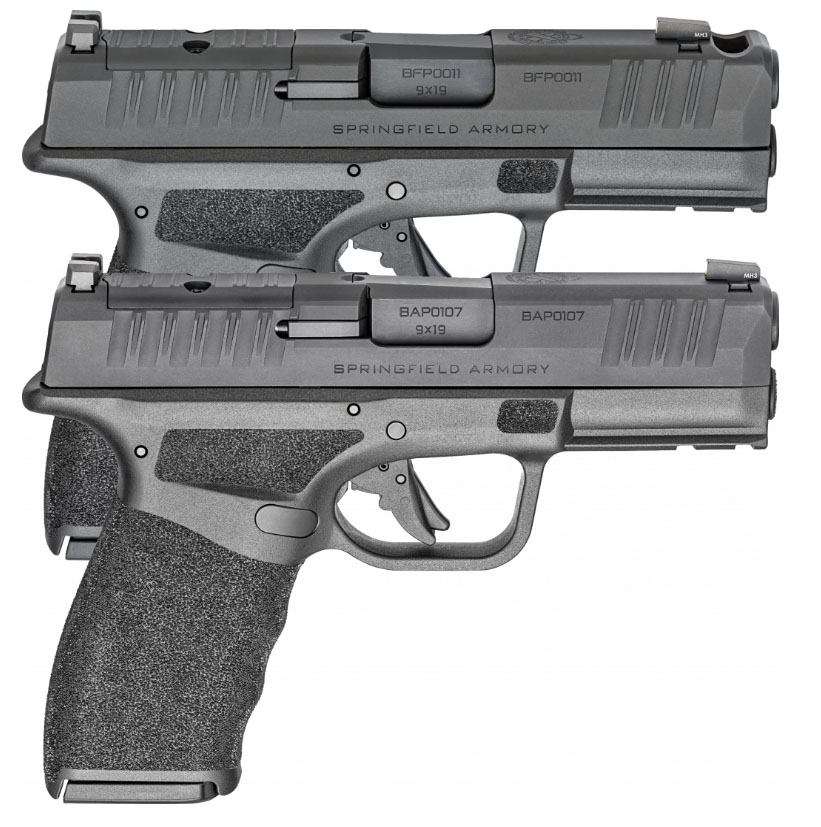
The Springfield Hellcat Pro Comp provides one of the clearest examples of a factory compensator not necessarily requiring a larger holster.
The standard Hellcat Pro and Hellcat Pro Comp share the same basic external dimensions. The compensated model remains 6.6 inches overall with a 3.7-inch barrel, 4.8-inch height and approximately 1-inch width.
Instead of adding length to the muzzle, Springfield machines the compensating system into the existing barrel and slide. The front sight is moved behind the port.
Published testing and product coverage specifically notes that the Hellcat Pro Comp fits standard Hellcat Pro holsters without requiring an open-muzzle design. Source: Shooting Illustrated
That's very different from attaching a compensator to the end of an existing threaded barrel.
The SIG P365-XMACRO Shows Why Model Names Matter
The P365 family provides another useful example.
The original P365 was published at approximately 5.8 inches overall with a 3.1-inch barrel. Source: SIG Sauer
The P365XL increased overall length to approximately 6.6 inches and uses a 3.7-inch barrel. Source: SIG Sauer
The original compensated P365-XMACRO is also approximately 6.6 inches overall, but SIG achieves that length using a 3.1-inch barrel and an integrally compensated XSeries slide. Source: SIG Sauer
| Model | Overall Length | Barrel Length | Configuration |
|---|---|---|---|
| P365 | 5.8" | 3.1" | Standard |
| P365XL | 6.6" | 3.7" | Longer slide / barrel |
| P365-XMACRO Comp | 6.6" | 3.1" | Integrated compensator |
Notice something important: the P365XL and compensated P365-XMACRO can share a similar published overall length while having different barrel and slide configurations.
That is exactly why Dara does not determine holster fit from one measurement.
Compensated Does Not Automatically Mean Longer
This is probably the biggest misconception worth clearing up.
Integral or Factory-Ported Designs
The manufacturer may machine the compensating system into the barrel and slide while maintaining the exterior envelope of an existing model.
The Hellcat Pro Comp is a good example. Its compensating system does not increase overall length compared with the standard Hellcat Pro, and standard Pro holster compatibility has been specifically documented. Source: Shooting Illustrated
Springfield followed a similar philosophy with the Echelon 4.0C Comp. The compensated pistol retains the 7.25-inch overall length and 4-inch barrel dimensions of the 4.0C platform. Source: American Rifleman
Extended Muzzle Configurations
Other designs extend the firearm beyond the dimensions of the standard slide.
When a compensator or other muzzle device extends beyond the original firearm, a closed-muzzle holster may physically prevent the firearm from seating completely.
An open-muzzle holster may provide additional clearance, but an open muzzle does not automatically make every compensated firearm compatible. Retention points, slide geometry, frame dimensions and other parts of the firearm still have to match the holster.
Open-Muzzle Holsters and Compensators
An open muzzle can provide additional clearance for a longer slide, threaded barrel or certain muzzle configurations, but it should never be treated as universal compatibility.
For example, if a compensator extends past the muzzle opening but the firearm otherwise matches the geometry the holster was designed around, an open muzzle may provide the physical space needed for the additional length.
However, if the compensator changes the width or shape of the firearm before it reaches the holster opening, or if another part of the pistol differs from the supported firearm, the gun may still not fit.
Muzzle clearance and holster compatibility are two different questions.
Weapon Lights Add Another Variable
A compensated pistol equipped with a weapon-mounted light introduces another layer of fit considerations.
Light-bearing holsters are designed around a specific firearm and weapon-light combination. The presence of a light does not make differences between compensated and non-compensated firearms irrelevant.
The firearm's accessory rail determines where the light sits relative to the frame. The holster then has to accommodate the firearm, the light and the relationship between the two.
Same pistol + different light does not automatically mean compatible.
Same light + different pistol does not automatically mean compatible.
Adding a compensator creates another variable that must be considered.
When ordering a Dara light-bearing holster, select the exact firearm and weapon-light combination specifically listed as supported.
Optics Can Matter Too
Many of today's factory compensated carry pistols are also optics ready.
The P365-XMACRO was introduced with an optics-ready compensated slide. Source: SIG Sauer
The Hellcat Pro Comp uses Springfield's OSP optics-ready configuration. Source: American Rifleman
The Echelon 4.0C Comp retains Springfield's Variable Interface System for mounting compatible red-dot optics. Source: American Rifleman
Smith & Wesson's M&P Metal Carry Comp is also optics ready and ships with multiple optic mounting plates. Source: American Rifleman
That means a modern compensated carry setup may require the holster to account for the exact pistol configuration, compensator or ported slide, optic and weapon light at the same time.
Aftermarket Compensators Are a Different Question
Factory-integrated compensation and aftermarket compensators should not be treated as interchangeable from a holster-fit standpoint.
A factory-integrated system may be engineered into the existing dimensions of the pistol. An aftermarket compensator attached beyond the original muzzle can increase overall length and change the profile entering or exiting the holster.
For that reason, owning a holster for the original firearm does not establish compatibility after changing the firearm's external muzzle configuration.
If a particular compensated configuration is not specifically listed as supported by Dara, customers should verify compatibility before ordering.
Why Published Dimensions Aren't Enough
Overall length, height and width are useful for comparing pistols, but a holster does not interact with a firearm as a simple rectangular object.
Two pistols can both be 7.25 inches long and still have completely different:
- Trigger guards
- Dustcovers
- Accessory rails
- Slide profiles
- Muzzle profiles
- Controls
- Frame geometry
- Optic locations
- Weapon-light positions
This is why simply measuring your pistol and comparing those numbers with another firearm is not a reliable way to determine whether it will fit the same Dara holster.
How Dara Determines Compensated Pistol Holster Compatibility
Dara Holsters' compatibility information is based on the actual firearm configurations used to develop our tooling.
We own the firearms used to develop and verify our holster fits. Rather than deciding that two firearms are compatible because an online specification sheet shows similar dimensions, we physically fit our holsters to the firearms they were designed around.
Each holster is also test fit with the appropriate firearm before it leaves our facility, allowing us to verify fit and retention before it is shipped to the customer.
This becomes especially important with compensated and ported firearms. A new model may have the same overall length as an existing pistol while using a different slide, barrel, muzzle or frame configuration. Conversely, a compensated model may physically fit the same Dara holster body as another configuration even though the internal barrel design is different.
When Dara states that a compensated or ported firearm fits, or does not fit, a particular Dara holster, that determination comes from our tooling, the firearms in our possession and physical fit testing rather than dimensions alone.
Will My Compensated Pistol Fit My Existing Holster?
There is no universal yes or no answer.
If the compensated version retains the same external geometry as the standard firearm, it may fit the same holster. The Hellcat Pro Comp demonstrates that this is possible.
If the compensator extends beyond the original slide, changes the muzzle profile or accompanies other dimensional changes, a different holster or different holster length may be required.
The safest rule when selecting a firearm-specific holster is simple:
If your exact compensated or ported firearm is listed by Dara, select that model. If it is not listed, do not assume another version of the pistol will fit simply because the model names or published dimensions are similar.
The Bottom Line
Factory compensated and ported carry pistols are becoming increasingly common, but there is no single rule for how compensation affects holster fit.
Some manufacturers integrate compensation without changing the external dimensions of the pistol. Others create longer or otherwise different firearm configurations. Aftermarket compensators can introduce additional dimensional changes beyond the factory firearm.
For holster selection, what matters is not simply whether the pistol is compensated. What matters is the actual external geometry of the complete firearm configuration being inserted into the holster.
That's why Dara develops firearm-specific tooling, maintains actual firearms for fit verification and test fits each holster before it ships.
When in doubt, select the exact firearm configuration listed on the Dara Holsters product page or contact us to confirm compatibility before ordering.
```