
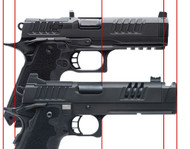
Do All 2011 Pistols Fit the Same Holster? Understanding 2011 Holster Compatibility
Posted by Dana Dara on Aug 12, 2026
Do All 2011 Pistols Fit the Same Holster?
No. A pistol being described as a 2011 does not mean it will fit a holster made for another 2011.
This is one of the most common misconceptions we see when customers shop for a 2011 holster. A customer will call in or email us asking if _____ model will fit a Staccato holster because they are both 2011's.
Two pistols may use the same general operating system, accept similar magazines and look nearly identical from the side, but that does not mean their external dimensions are identical where it matters to a holster.
For a holster manufacturer, the question is not simply whether two firearms are both 2011s. The question is whether the dimensions and geometry that interact with the holster are compatible.
Those dimensions can include the trigger guard, dust cover, accessory rail, slide, muzzle, controls and other external features. On a light-bearing holster, the weapon light itself also becomes a major part of the fit and retention geometry.
2011 is a firearm platform. It is not a universal holster-fit specification.
At Dara, we build holsters around specific firearm configurations rather than treating "2011" as a universal fitment. If we list a holster for a specific 2011 model, our goal is for that holster to be purpose-built around the geometry of that firearm or a combination we have physically verified as compatible.
What Does "2011" Actually Tell You About Holster Fit?
The term 2011 is commonly used to describe modern double-stack pistols based on the 1911 operating system and architecture. Today, there are numerous manufacturers producing pistols that fall into or are commonly associated with this category.
From a holster manufacturing standpoint, however, the name of the platform tells us very little about whether two individual pistols can correctly use the same holster.
There is no universal external dimensional standard that requires every pistol described as a 2011 to have an identical:
- Trigger guard
- Dust cover
- Accessory rail
- Slide profile
- Slide length
- Frame width
- Muzzle profile
- Control geometry
- Optic position
- Weapon-light position
Those differences are exactly what a holster manufacturer has to evaluate when determining firearm compatibility.
How a Molded Holster Actually Fits a Pistol
A properly fitted Kydex or Boltaron holster is formed around specific external geometry of the firearm or firearm-and-light combination.
That makes holster compatibility way more complicated than comparing the overall length and width specifications listed on two manufacturers' websites.
A dimensional difference of only a small amount can matter if that difference occurs at an area used for clearance, indexing or retention.
Conversely, two pistols can have different overall lengths and still be compatible with the same holster if the dimensional differences occur in areas that do not interfere with that particular holster design. Such as the Staccato XC/XL and the HD P4/P4.5.
This is why overall firearm dimensions alone cannot reliably determine holster compatibility.
Firearm-Specific Fit Can Mean Less Interchangeability
One consequence of designing a holster around specific firearm geometry is that tighter, more firearm-specific fitment can reduce interchangeability with similar-looking pistols.
A holster designed with broad clearances may physically accommodate a wider range of firearms. Dara takes a more firearm-specific approach. When differences between two pistols affect the areas responsible for clearance, seating or retention, we would rather maintain separate fitments than assume that "close enough" is acceptable.
This is why having more firearm-specific options in our menu is intentional. Some models legitimately share a Dara holster because we have verified the compatibility. Others require their own tooling even when they appear nearly identical.
The Trigger Guard Can Determine Holster Compatibility
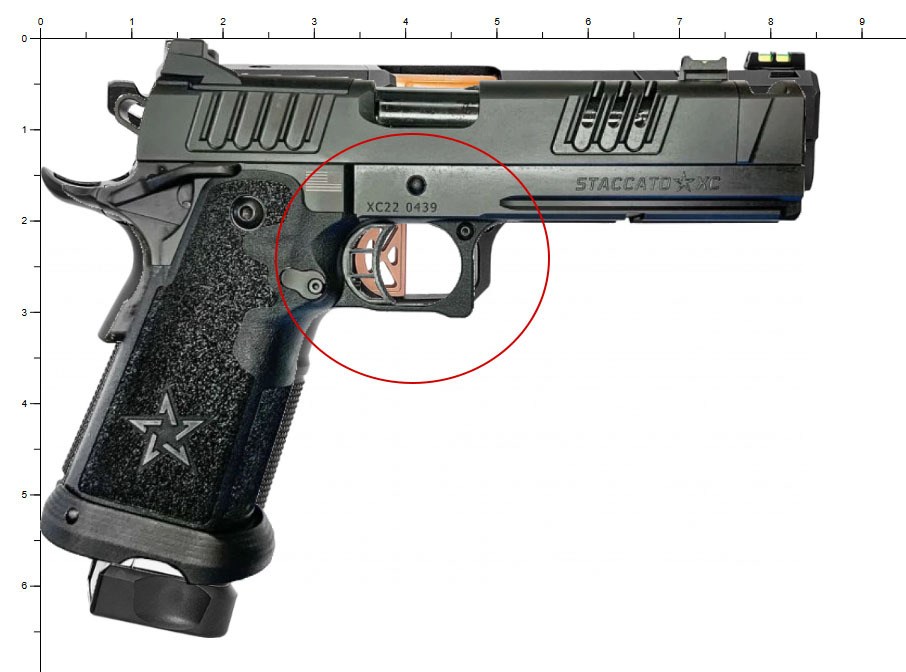
On many non-light-bearing thermoplastic holsters, the trigger guard is an important part of the holster's retention geometry. As you can see above, not all 2011's have the same trigger guard shape.
The molded holster can create controlled interference around specific areas of the trigger guard. As the pistol is inserted, the holster material flexes and then returns around the retention area. That action is the audible "click" you hear when a firearm is fully seated in the holster.
If another 2011 has a different trigger guard width, contour, length or transition into the frame, the retention characteristics can change.
A pistol may appear to enter the holster while still having incorrect retention.
This distinction is important: being physically capable of going into a holster is not the same thing as being correctly fitted to that holster.
Dust Cover and Accessory Rail Geometry Matter
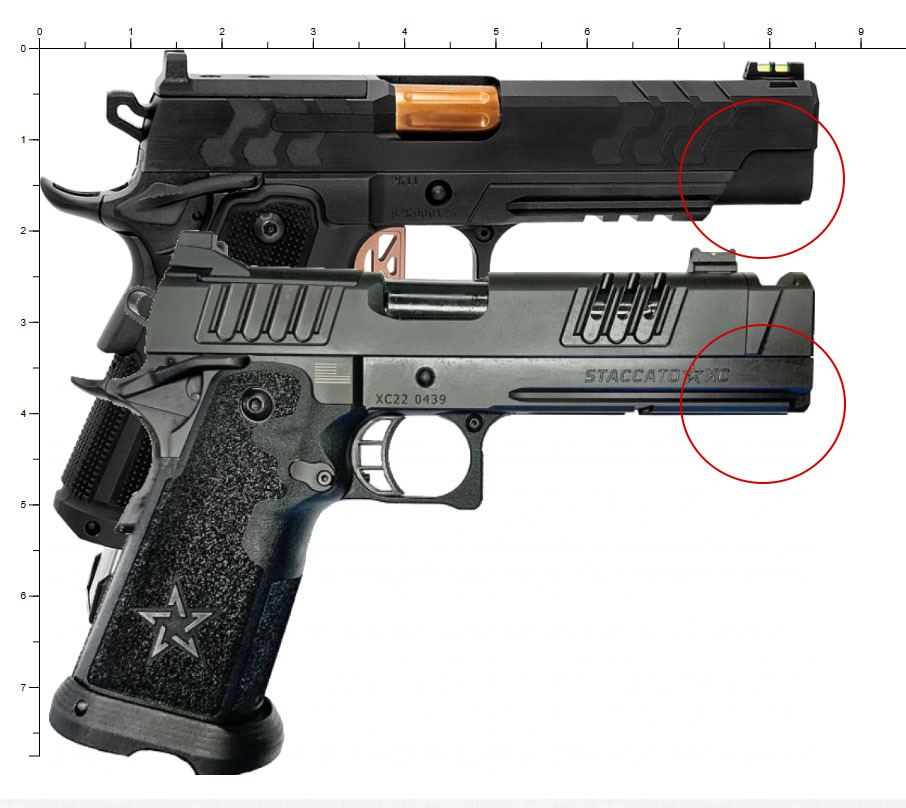
The area of the frame forward of the trigger guard is another major source of dimensional differences between 2011-style pistols.
Manufacturers can use different dust-cover lengths, widths and profiles. Accessory rails can also vary in geometry and location.
These differences can change how the pistol travels through the holster and can prevent the firearm from fully seating within the holster.
A difference in this area can result in excessive interference, insufficient retention, improper seating or a firearm that simply will not fully enter the holster.
Why Barrel Length Alone Does Not Determine Holster Compatibility
Barrel length is useful information, but it should never be treated as a holster compatibility measurement.
Two pistols advertised with the same barrel length can still have different slide dimensions and external profiles.
Likewise, two pistols with different barrel lengths may sometimes use the same holster.
A holster manufacturer must consider characteristics such as:
- Slide length
- Slide width
- Slide height
- Front-end geometry
- Slide contour
- Location of external features
- Muzzle configuration
This is one reason shopping for a holster based only on statements such as "4-inch 2011" or "5-inch 2011" can lead to incorrect fitment.
A difference in barrel length does not automatically mean two pistols require different holsters. Likewise, matching barrel lengths do not automatically mean two pistols can use the same holster.
What matters is how the dimensional differences affect the particular holster.
For example, an open-muzzle holster may allow a longer barrel or muzzle assembly to extend beyond the end of the holster, provided the rest of the firearm's geometry remains compatible with the holster.
However, changing barrel or slide length can also change other dimensions or cause components to contact areas of the holster that were not designed for them.
Compatibility therefore has to be determined using the complete firearm geometry rather than barrel length alone.
Compensated 2011 Pistols Require Additional Consideration
Compensators and sight blocks add another variable to 2011 holster fitment.
An integral or attached component at the muzzle can change the external profile of the firearm even when the pistol shares other components with a related model.
For a holster manufacturer, the important questions include whether that component can pass through the holster, whether sufficient clearance exists around it and whether the pistol can reach its intended seating position without interference.
This is particularly relevant with performance-oriented 2011 pistols, where two models within the same product family may use significantly different muzzle configurations.
Why Light-Bearing 2011 Holsters Are Different
Adding a weapon-mounted light changes the geometry that a holster manufacturer has to work with.
In many firearm-specific, light-bearing holster designs, retention occurs around the weapon light or light/rail area rather than relying on the same trigger-guard geometry used by a non-light-bearing holster.
That means a light-bearing holster is developed around a specific firearm + weapon light combination.
The dimensions that matter now include both the firearm and the light:
- Weapon-light body width
- Weapon-light body height
- Position of the light beneath the frame
- Rail location
- Light mounting interface
- Switch geometry
- Clearance between the light and trigger guard
- Firearm frame and slide geometry
This is why installing the same weapon light on two different 2011 pistols does not automatically make those pistols holster-compatible.
It is also why changing from one weapon light to another can require a different holster even when the firearm itself has not changed.
Why Light-Bearing Holsters Have More Trigger-Guard Clearance
There is another important manufacturing consideration with light-bearing holsters.
In order for a pistol equipped with a weapon light to enter the holster, the holster opening must provide enough clearance for the light to pass through.
Most full-size weapon lights are wider than the trigger guard positioned behind them.
The holster therefore cannot always follow the trigger guard as tightly as a comparable non-light-bearing holster because the larger weapon light has to pass through that same area during insertion and removal.
This is a geometric limitation inherent to many light-bearing holster designs and is another reason the exact firearm-and-light combination must be considered during holster development.
This is also why a light-bearing holster may not produce the same pronounced retention "click" as a comparable non-light-bearing holster. The retention geometry is different because the holster must provide clearance for the weapon light.
Why "It Clicks In" Does Not Prove Correct Holster Fit
Customers will sometimes test an unsupported pistol in a holster and conclude that the combination is compatible because the firearm goes into the holster or produces an audible retention click.
That alone does not establish proper compatibility.
A holster manufacturer has to consider more than whether the firearm can be inserted.
Fit evaluation can include:
- Whether the firearm reaches its intended seating depth
- Whether the intended retention surfaces are actually engaging
- Whether retention is consistent
- Whether there is excessive movement
- Whether controls are being contacted
- Whether the trigger guard is appropriately covered
- Whether the slide, frame or accessories bind during insertion or draw
- Whether an active retention device properly interfaces with the firearm
A firearm fitting into a holster and a firearm being properly supported by that holster are two different things.
Active Retention Makes Compatibility Even More Important
Compatibility becomes even more important when an active retention system is added.
A duty holster does not rely exclusively on friction or passive retention. An active retention device must engage the firearm in a predictable location and operate correctly with that firearm's dimensions.
Changing the firearm without verifying compatibility can change the relationship between the pistol and the retention components.
This is why duty-holster compatibility should never be determined solely by whether an unsupported firearm appears to fit inside the holster body.
The firearm, holster body and retention system have to function together as a complete system.
Real Examples: Staccato 2011 Holster Compatibility
Staccato XC vs. HD P4.5: Similar Size, Different Holsters
Staccato provides a good example of why the 2011 designation, manufacturer name and barrel length alone cannot determine holster compatibility.
Consider the Staccato XC and Staccato HD P4.5. Both are manufactured by Staccato, both are part of the broader 2011 platform, and both are similar in overall size. However, they are different firearm designs and do not fit the same Dara holster.
| XC | HD P4.5 | |
| Length | 8.7" | 8.1" |
| Width | 1.5" | 1.6" |
| Height | 5.9" | 5.6" |
The difference is not simply the half-inch difference in their stated barrel configurations. The XC and HD P4.5 use different firearm architecture and external geometry in areas that affect how the pistol interfaces with a holster.
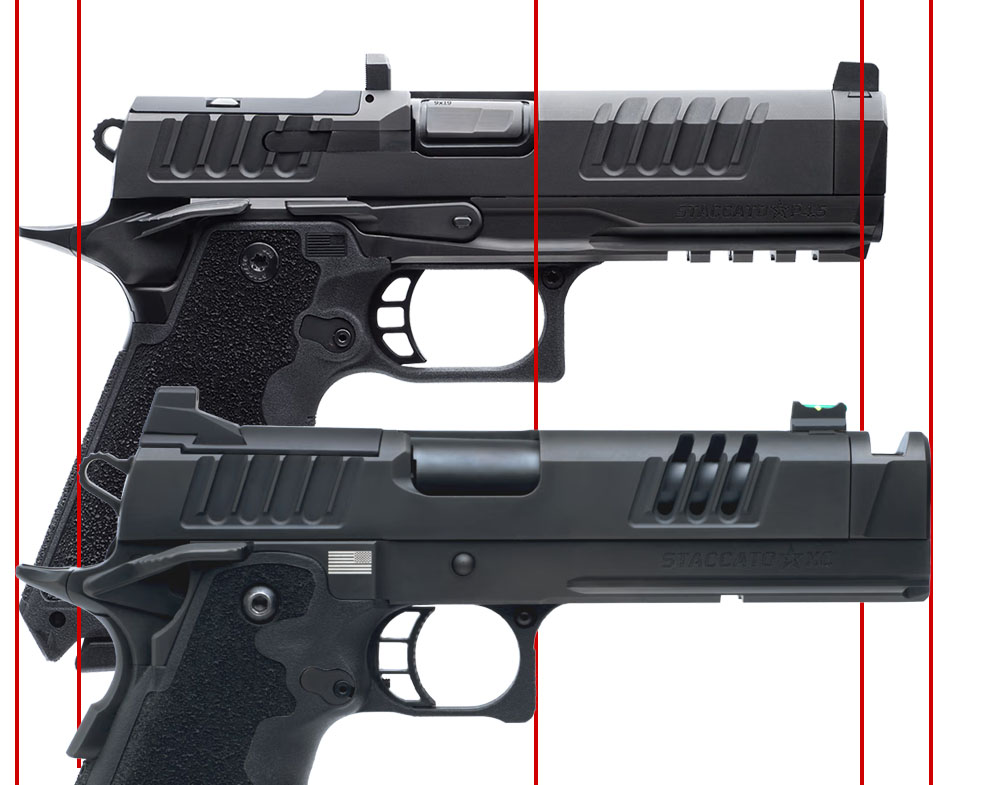
From a holster manufacturer's perspective, this is why a description such as "Staccato holster," "2011 holster" or even a general barrel-length category is not enough to establish fitment. The actual firearm geometry has to be considered.
Staccato HD P4 vs. HD P4.5: Different Lengths, Same Dara Holster
The opposite can also be true. Two pistols with different barrel lengths may fit the same holster when the geometry that interfaces with that particular holster remains compatible.
The Staccato HD P4 and HD P4.5 demonstrate the opposite side of the compatibility question.
These two pistols do not have the same barrel configuration or overall length.
The HD P4 uses a 4.0-inch bull barrel, while the HD P4.5 uses a 4.5-inch sight-block barrel configuration.
Despite that difference, Dara's HD P4 and HD P4.5 are compatible with the same Dara holster.
Why?
Because barrel length alone does not determine holster compatibility. In this particular application, the dimensional differences between the P4 and P4.5 do not prevent the two pistols from correctly interacting with the areas of the Dara holster responsible for fit and retention.
This does not mean that all 4-inch and 4.5-inch 2011 pistols are interchangeable.
It means that compatibility is determined by the complete firearm and holster geometry, not by a single specification.
This is why holster compatibility has to be established using the actual firearm configuration, not inferred from the platform name, manufacturer or barrel length.
A 2011 From Another Manufacturer Is Still a Different Firearm
This becomes even more important when comparing pistols from different manufacturers.
Two manufacturers may both produce double-stack 1911-style pistols with the same nominal barrel length, but that does not mean the pistols were manufactured to identical external dimensions.
Differences can exist in the trigger guard, frame, dust cover, accessory rail, slide, muzzle and controls.
Those are not cosmetic differences to a holster manufacturer. They are dimensions that can directly affect fit, clearance and retention.
For that reason, a holster made for a Staccato should not automatically be assumed to fit a different manufacturer's 2011-style pistol.
How Dara Develops a Holster Fitment for a 2011
When Dara develops support for a new 2011-style pistol, we start with the actual firearm rather than assuming it shares the dimensions of another pistol in the same category.
Our development process can include 3D scanning the firearm to capture its external geometry, creating a digital model, developing the holster and production tooling in CAD, and CNC machining firearm-specific molds used in our thermoforming process.
This allows us to evaluate and build around the areas of the firearm that actually interact with the holster, including the trigger guard, frame, dust cover, accessory rail, slide, muzzle and external controls.
Once a fitment enters production, Dara uses the actual firearm model to test-fit completed holsters before shipment. This gives us a physical confirmation of the firearm and holster combination instead of relying solely on published firearm dimensions.
We build around the firearm, not the 2011 category.
For a look at this process, watch our firearm mold manufacturing video, which shows how Dara develops production tooling from a firearm model.
Why Dara Uses Firearm-Specific Production Tooling
When a new 2011 differs enough from an existing firearm to affect holster fit, Dara can develop dedicated production tooling for that firearm rather than forcing it into an existing fitment.
That means two pistols may receive separate Dara firearm options even when they appear extremely similar. Conversely, if physical testing establishes that multiple firearms correctly interact with the same holster geometry, Dara can list those firearms as compatible with the same fitment.
The goal is not to create a separate mold simply because a firearm has a different model name. The goal is to use separate tooling when the geometry that matters to the holster actually requires it.
Production Tooling Is Also Maintained and Replaced
Creating an accurate firearm mold is not a one-time process that is forgotten once a holster enters production.
Dara's holster molds are repeatedly used under heat, vacuum and normal production handling. Tooling can wear over time, and a mold that is dropped, chipped or otherwise damaged is replaced rather than continuing to be used.
Dara also periodically retools firearm models as part of maintaining our production standards. This gives us another opportunity to verify the firearm, review the production geometry and make sure the tooling still produces the fit we expect.
Combined with physical firearm fit-testing before shipment, this gives Dara multiple opportunities to verify compatibility from initial firearm development through final production.
See how Dara manufactures its holsters in our Holster Manufacturing Process.
Why Dara Does Not Label a Holster "Fits All 2011s"
Dara Holsters manufactures firearm-specific holsters rather than assuming that every pistol within a broad platform category is dimensionally interchangeable.
When we list a firearm as compatible with a holster, we are identifying a specific firearm configuration that our tooling and holster design are intended to accommodate.
Sometimes multiple firearm models can legitimately use the same holster. When we have established that compatibility, we can list those models accordingly.
Other times, two pistols that appear nearly identical require separate tooling.
That determination is based on the geometry of the actual firearms and the design of the holster, not simply the model family printed on the slide.
At Dara Holsters, firearm compatibility does not end when the CAD model or production mold is completed. We use the actual firearm model to test-fit completed holsters before shipment.
This allows our production team to physically verify seating and retention using the firearm the holster was designed to support. If a firearm is not explicitly listed in our ordering menu, we cannot perform that same model-specific confirmation and therefore do not recommend substituting another 2011 simply because it appears dimensionally similar.
What Information Actually Determines 2011 Holster Compatibility?
If you are trying to determine whether a 2011 will fit a particular holster, the correct starting point is the exact firearm configuration.
That includes:
- Manufacturer
- Exact model
- Model generation or revision when applicable
- Compensator, if equipped
- Weapon-mounted light manufacturer and exact model
- Optic and optic position when relevant
- Other external components that alter the firearm's profile
Do not determine holster compatibility solely from caliber, barrel length or the fact that the firearm is a 2011.
Which 2011 Pistols Does Dara Currently Make Holsters For?
Dara currently manufactures firearm-specific holsters for a growing number of 2011 and double-stack 1911-style pistols. Current supported models include:
2011 firearm support last reviewed: September 2026. Available firearm and weapon-light options may change as Dara develops and validates new fitments.
Staccato
- Staccato P
- Staccato XC
- Staccato XL
- Staccato HD P4
- Staccato HD P4.5
- Staccato C4X
Springfield Armory
- Springfield Armory Prodigy 4.25"
- Springfield Armory Prodigy 5"
Kimber
- Kimber 2K11 5"
- Kimber 2K11 Target 5"
- Kimber 2K11 Pro Coyote 4.25"
- Kimber 2K11 Pro Minotaur 4.25"
OA
- OA Original
- OA Pro
OA Pro Elite: The OA Pro Elite is not currently included in Dara's listed OA fitment. Do not select the OA Pro for an OA Pro Elite unless Dara has specifically confirmed compatibility.
Because firearm support continues to expand, always check our Supported Firearms List for current availability.
If your exact 2011 is not listed, use our Firearm Request Form rather than selecting a similar model.
2011 Holster Compatibility: The Bottom Line
There are 50 shades of 2011 and not all 2011 pistols fit the same holster.
The 2011 designation describes a firearm platform, not a standardized external envelope for holster manufacturers.
Trigger guard geometry, dust-cover dimensions, accessory rails, slide dimensions, muzzle configuration, compensators and weapon-mounted lights can all affect holster fit.
At the same time, different barrel lengths do not automatically require different holsters. Certain models can share a holster when the geometry relevant to that particular holster remains compatible.
That is why Dara determines compatibility by specific firearm and accessory configuration rather than simply labeling a product as a universal 2011 holster.
If your exact 2011 is listed in our firearm options, select that model when ordering. If it is not listed, do not substitute another 2011 simply because the dimensions appear similar.
View Dara Holsters' Supported Firearms
Request Holster Support for Your Firearm
2011 Holster Compatibility FAQs
Do all 2011 pistols fit the same holster?
No. The 2011 platform does not establish universal external dimensions. Trigger guards, frames, dust covers, rails, slides and muzzle configurations can vary between models and manufacturers.
Will any 4-inch 2011 fit a 4-inch 2011 holster?
No. Barrel length alone does not determine holster compatibility. Two 4-inch pistols can have different trigger guards, frame dimensions, slide profiles and accessory-rail geometry.
Will a Staccato holster fit another brand of 2011?
Do not assume that it will. A pistol from another manufacturer may use different external dimensions even if it has the same barrel length and general 2011-style architecture.
Can two 2011 pistols with different barrel lengths fit the same holster?
Yes, in certain verified configurations. Different barrel lengths do not automatically prevent two pistols from sharing a holster. The Staccato HD P4 and HD P4.5 are an example of two different-length configurations that fit the same Dara holster.
Why does trigger guard shape matter?
On many non-light-bearing molded holsters, geometry around the trigger guard contributes to passive retention. Changes in the size or shape of the trigger guard can therefore change how the holster fits and retains the firearm.
Why does the weapon light matter?
In many light-bearing holsters, the weapon light or light/rail area becomes a primary part of the holster's fit and retention geometry. Changing the light can therefore change the required holster configuration.
If my 2011 clicks into the holster, does that mean it fits?
Not necessarily. An audible or tactile click only indicates that some portion of the firearm has passed an interference point. It does not by itself confirm correct seating, retention, clearance, trigger-guard coverage or active-retention operation.
Can I use a light-bearing holster without the weapon light installed?
Do not assume that you can. Many firearm-specific light-bearing holsters rely on the weapon light or light/rail area for retention. Removing the light can substantially change or eliminate the intended retention characteristics of the holster.
How do I know whether Dara makes a holster for my 2011?
Check Dara's supported firearm list and select your exact manufacturer, model and weapon-light configuration when ordering. If your exact firearm is not listed, submit a firearm request rather than selecting a similar 2011 model.