
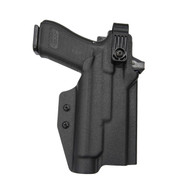
Law Enforcement Holster Guide: Concealed, Level 2 and Level 3 Duty Holsters
Posted by Dana Dara on Sep 17, 2026
Choosing a holster for law enforcement or professional security starts with the assignment. A plainclothes investigator who needs to keep a firearm concealed has very different requirements from a uniformed patrol officer whose agency requires Level 3 retention.
Firearm configuration matters too. The exact pistol, weapon-mounted light, optic, duty belt and required retention level can all affect which holster and mounting system should be used.
Dara Holsters & Gear designs and manufactures holsters in North Carolina for concealed carry, professional use and duty applications. This guide explains how officers, armed security professionals, executive protection personnel and agencies can choose between the Dara Concealment System, Level 2 Duty Holster and upcoming D3 Level 3 Duty Holster.
Which Holster Does an Officer Need?
The first question should be whether the assignment requires concealment, Level 2 retention or Level 3 retention.
| Assignment or Requirement | Recommended Dara Holster |
|---|---|
| Plainclothes law enforcement | Dara Concealment System |
| Detectives and investigators | Dara Concealment System |
| Executive protection requiring discreet carry | Dara Concealment System |
| Plainclothes pistol equipped with a weapon-mounted light | Light-Bearing Dara Concealment System |
| Armed security permitted to use Level 2 retention | Dara Level 2 Duty Holster |
| Executive protection requiring active Level 2 retention | Dara Level 2 Duty Holster |
| Level 2 duty pistol equipped with a weapon-mounted light | Light-Bearing Level 2 Duty Holster |
| Agency or assignment requiring Level 3 retention | D3 Level 3 Duty Holster |
Agency policy should always determine the minimum required retention level. A holster appropriate for a plainclothes investigator may not meet the equipment requirements of a uniformed patrol assignment.
What Is the Difference Between Concealment, Level 2 and Level 3 Retention?
A concealment holster prioritizes discreet carry, firearm security, accessibility and keeping the holstered trigger protected. It may be appropriate for plainclothes personnel when an agency does not require an active-retention duty holster.
A Level 2 duty holster incorporates an additional active retention mechanism that must be intentionally defeated during the draw. Dara's Level 2 Duty Holster combines adjustable passive retention with an active rotating retention hood operated by a thumb control.
A Level 3 duty holster adds another retention mechanism. Dara's D3 combines an automatic Ejection Port Locking system, or EPL, with the Rapid-Deploy Hood to provide Level 3 retention.
The appropriate level is not simply a matter of preference. Officers and agencies should select a holster that complies with their department or organization's equipment and retention requirements.
Holsters for Plainclothes Police Officers, Detectives and Investigators
For officers who need to carry discreetly, we recommend the Dara Concealment System (DCS).
The DCS was designed to give the user several carry configurations without requiring a separate holster body for each one. That can be particularly useful for officers whose clothing and assignments change.
The DCS can be configured four ways:
- Single-clip AIWB or IWB
- Dual-clip AIWB or IWB
- Appendix rig with detachable magazine carrier
- Concealable OWB
The magazine carrier can also be removed and carried separately.
An investigator wearing casual clothing may choose IWB carry, while the same officer working in a jacket may prefer a close-riding OWB configuration. The DCS allows those configurations to be built around the same firearm-specific holster body.
Can a Plainclothes Officer Carry a Full-Size Duty Pistol Concealed?
The DCS is available for numerous compact and full-size pistols. However, whether a particular firearm can be effectively concealed depends on more than the holster.
Firearm dimensions, clothing, body type, carry position, belt selection and other equipment can all affect concealment. Officers should choose a firearm and carry position appropriate for their assignment and agency requirements.
Standard DCS or Light-Bearing DCS?
The firearm's configuration determines which version of the DCS should be ordered.
If the pistol does not have a weapon-mounted light, select the standard Dara Concealment System.
If the pistol has a weapon-mounted light, select the Light-Bearing Dara Concealment System.
A light-bearing holster is designed around the dimensions of both the firearm and weapon-mounted light. Officers should therefore select the exact supported firearm and light combination when ordering.
A light-bearing pistol should not be assumed to work correctly in a holster designed for the same firearm without the light, or vice versa.
DCS Construction
The DCS incorporates Squadron, Tegris and a precision-machined 6061 aluminum concealment claw. The system provides adjustment for ride height, cant and sweat-shield configuration and is designed for use with compatible slide-mounted optics.
The DCS was developed for users who need a durable concealment platform that can adapt to different professional assignments and carry positions.
Level 2 Duty Holsters for Armed Security and Professional Use
For armed security, executive protection and other professional applications where active retention is required but Level 3 retention is not mandated, we recommend the Dara Level 2 Duty Holster.
The Dara Level 2 Duty Holster combines adjustable passive retention with an active rotating hood.
The active retention hood is released using a thumb-operated control as part of the draw sequence. The holster body is manufactured from .125-inch Kydex or Boltaron and assembled using black oxide coated stainless steel hardware.
The system is designed around professional duty use rather than adding an aftermarket retention device to a standard OWB holster.
Standard or Light-Bearing Level 2 Duty Holster?
For a pistol without a weapon-mounted light, select the standard Level 2 Duty Holster.
For a pistol equipped with a weapon-mounted light, select the Light-Bearing Level 2 Duty Holster.
The Light-Bearing Level 2 is formed for the selected firearm and weapon-mounted light combination. Weapon lights are not universally interchangeable in a duty holster simply because they are attached to the same firearm.
Can Dara Level 2 Holsters Accommodate Red Dot Optics?
Yes. Dara Level 2 Duty Holsters are optics ready and are designed with clearance for suppressor-height sights.
Different optic configurations may require different hood configurations. Dara offers Regular and Tall hood options, with the Tall configuration intended for larger optics including many enclosed-emitter configurations.
Officers should verify their firearm, optic and weapon-light configuration when selecting a holster.
Can the Level 2 Thumb Control Be Changed?
Yes. Dara offers a Level 2 Control Kit that allows the user to change the size and style of the retention control.
The system provides small and medium push-style controls as well as a larger lever-style control. This allows the release interface to be configured around factors such as hand size, gloves and user preference without replacing the entire holster.
Will Aftermarket Firearm Parts Affect Holster Fit?
They can.
Dara holsters are developed around specific firearm configurations. Aftermarket components that change the external dimensions of the pistol can affect holster fit or interfere with retention components.
Examples can include aftermarket frames, slides, oversized controls, thumb rests, gas pedals, compensators and other dimensional modifications.
Agencies and officers using modified firearms should confirm compatibility with Dara before ordering rather than assuming that a component will fit because the base firearm model is supported.
Duty Belt Attachments: Dara DBL Series
The connection between a duty holster and the officer's belt is an important part of the complete system. Ride height, cant, belt width, rigidity and interaction with body armor can all influence how the firearm sits and how consistently it can be accessed.
Dara developed the DBL Series as a lightweight machined-aluminum duty holster mounting system.
Instead of using a separate belt loop attached to a separate drop component, the DBL design integrates the belt attachment and drop into a single machined component.
The DBL Series is CNC machined from 6061-T6 billet aluminum and provides a rigid connection between the duty belt and holster while keeping the mounting system streamlined.
Depending on the configuration, the DBL system supports duty belts from approximately 1.5 inches through 2.25 inches and provides up to approximately +/-30 degrees of cant adjustment.
Dara offers different DBL configurations and ride heights so officers can position the holster around body armor, equipment and individual draw preferences.
Learn more about the Dara DBL Series and DBL2 Holster Attachment.
Can an Officer Quickly Move a Holster Between Belts or Mounting Platforms?
For users who need a quick-disconnect system, Dara offers the ALQD Auto Locking Quick Disconnect System.
The ALQD uses a holster-mounted component and a receiver mounted to the compatible belt attachment or mounting platform. When the components are connected, the system automatically locks into place.
A secondary manual safety provides an additional safeguard against unintended disengagement.
This allows an officer to remove or exchange a compatible holster without removing the complete belt attachment.
Potential applications include switching between compatible holsters, maintaining separate training and duty configurations, moving equipment between compatible mounting locations or removing a holster from a belt when it is not needed.
The ALQD is compatible with Dara's 3-point mounting pattern and can be incorporated into compatible DBL and other Dara mounting configurations.
In Dara's own breakaway testing, the ALQD has demonstrated the highest breakaway point of the holster attachment systems evaluated by the company.
Learn more about the Dara ALQD Auto Locking Quick Disconnect System.
D3 Level 3 Duty Holster for Law Enforcement
When an agency requires Level 3 retention, Dara's next-generation duty platform is the D3 Level 3 Duty Holster.
The D3 was designed around three priorities: a retention system the user can depend on, a platform that can adapt to different requirements and the ability to support the firearms professionals actually carry.
The D3 combines an automatic Ejection Port Locking mechanism, or EPL, with Dara's Rapid-Deploy Hood to provide Level 3 retention.
How Does the D3 Retain the Firearm?
The EPL is an internal retention mechanism that automatically engages when the firearm is properly holstered. The officer does not need to separately activate the EPL after reholstering.
The Rapid-Deploy Hood provides another active retention barrier. Together, the EPL and hood create the D3's Level 3 retention system.
The system was designed to provide positive firearm retention while maintaining an intuitive and repeatable draw sequence.
What Happens if the D3 Hood Is Obstructed?
The Rapid-Deploy Hood incorporates a manual power override.
This feature was designed so the user has a mechanical method of moving the hood if normal hood movement becomes obstructed.
For professional users operating around vehicles, other personnel, body armor and unpredictable environments, the ability to mechanically override an obstructed component was an intentional part of the D3 design.
D3 Modular Protection System
The D3 incorporates Dara's Modular Protection System, allowing protective components to be configured around the officer's requirements.
The system includes:
- Automatic EPL internal locking system
- Rapid-Deploy Hood
- Manual hood override
- Removable Patrol Guard
- Removable Optic Shroud
- Enclosed protection around the optic
- Single-piece thermoformed holster body
- Ability to configure the platform as Level 2 or Level 3
The removable Patrol Guard and Optic Shroud allow the protective configuration of the holster to be changed without requiring an entirely different holster body.
Can the D3 Be Converted from Level 3 to Level 2?
Yes. The D3 was designed as a modular system and can be configured as a Level 2 or Level 3 retention holster.
This gives agencies additional flexibility when different assignments or personnel require different retention configurations while using the D3 platform.
Why Does the D3 Use a Thermoformed Body Instead of an Injection-Molded Holster Body?
This is one of the most important design decisions behind the D3.
Many duty holsters rely on injection-molded bodies. Injection molding is well suited to large-volume manufacturing, but creating tooling for a completely new firearm configuration can be expensive and time consuming.
That can become a problem when an agency adopts a recently released pistol and compatible professional duty holsters are not yet available.
The D3 instead uses a single-piece thermoformed holster body.
Dara manufactures holsters using firearm-specific tooling, allowing us to develop new fits without waiting for an entirely new injection mold for every firearm configuration.
This gives Dara a substantially shorter tooling and development path when adding support for new duty pistols.
It does not mean an untested firearm is automatically compatible with an existing D3. Each new firearm configuration still has to be developed and evaluated. The advantage is that the thermoforming manufacturing process allows Dara to move from development to production significantly faster than would typically be possible when completely new injection tooling is required.
For agencies evaluating newer duty pistols, this manufacturing approach is intended to reduce one of the common problems associated with firearm transitions: waiting for the holster market to catch up.
How Was the D3 Developed and Tested?
The D3 was developed through continued evaluation and feedback from the people the holster was designed for.
Throughout development, Dara received input from law enforcement officers, military personnel, executive protection professionals, firearms instructors and experienced shooters.
The retention system and holster were evaluated through repeated draw and reholstering, physical retention testing and hands-on professional evaluation.
Dara also conducted physical mat testing intended to evaluate the holster and retention system under direct attempts to gain control of the firearm.
Feedback gathered throughout this process was used to refine the retention system, controls, protective components and overall configuration before release.
How Quickly Can Dara Support a New Duty Pistol?
There is no universal lead time for adding a new firearm because every pistol has to be evaluated individually.
However, Dara's thermoforming manufacturing process allows firearm-specific tooling to be developed without the significantly longer tooling process associated with creating an entirely new injection-molded holster body.
This is particularly important as agencies adopt newer duty pistols and configurations.
If an agency is considering a firearm that is not currently listed, contact Dara before placing an order. New firearm support is evaluated based on the firearm, configuration, professional demand and development requirements.
Can Dara Support Different Firearms Within the Same Agency?
Yes. Dara holsters are firearm-specific, so an agency can order holsters for multiple supported firearm configurations rather than requiring every officer to use the exact same handgun solely for holster compatibility.
However, each holster must be ordered for the officer's actual firearm configuration.
For light-bearing holsters, that includes the weapon-mounted light. Agencies should also identify relevant optic configurations and any firearm modifications that could affect fit.
What Information Should an Agency Collect Before Ordering Holsters?
Before requesting a quote or submitting a purchase order, agencies should identify the equipment configurations that will be used.
Useful information includes:
- Firearm manufacturer
- Firearm model and specific variant
- Generation, when applicable
- Barrel or slide length
- Weapon-mounted light manufacturer and model
- Optic configuration
- Required retention level
- Duty belt width
- Preferred ride height or attachment configuration
- Any aftermarket firearm components that may affect fit
- Right- or left-handed configuration where applicable
- Quantity required
Providing complete firearm and equipment information helps Dara confirm compatibility before an agency order enters production.
Does Dara Offer Agency and Bulk Ordering?
Yes. Dara works directly with law enforcement agencies and professional organizations purchasing duty holsters and related equipment.
Departments can contact Dara regarding larger orders, firearm compatibility, mounting configurations and purchasing requirements.
Dealer and distributor programs are also available for qualified organizations interested in carrying Dara professional equipment.
D3 Availability and Agency Pre-Orders
The D3 Level 3 Duty Holster is scheduled to launch in January 2027.
Dara is currently accepting agency pre-orders ahead of the official release.
Agencies planning firearm transitions, equipment purchases or upcoming duty-gear programs are encouraged to contact Dara ahead of the launch, particularly when new firearm configurations need to be evaluated.
What Warranty Does Dara Provide?
Dara Holsters backs its holsters with a lifetime warranty against manufacturing defects.
Unauthorized alterations or modifications to the holster can affect its function and void warranty coverage. Officers and agencies that need a different configuration should contact Dara rather than cutting, drilling or otherwise modifying the holster body or retention system.
Choosing the Right Dara Holster for the Assignment
For plainclothes law enforcement, investigators, detectives and executive protection professionals who need discreet carry, start with the Dara Concealment System. If the firearm has a weapon-mounted light, select the Light-Bearing DCS.
For armed security, executive protection and other professional assignments where Level 2 active retention is appropriate, select the Level 2 Duty Holster or Light-Bearing Level 2 Duty Holster.
For law enforcement agencies and professional users requiring Level 3 retention, the D3 Level 3 Duty Holster provides automatic EPL retention, the Rapid-Deploy Hood and Dara's Modular Protection System in a thermoformed platform designed to accommodate new firearm fits without the long tooling process associated with a completely new injection-molded holster body.
For duty-belt mounting, the DBL Series provides a machined aluminum belt attachment and drop system. Officers who need quick removal or interchangeability can incorporate the ALQD Auto Locking Quick Disconnect System into compatible configurations.
Law Enforcement and Agency Orders
Dara Holsters & Gear designs and manufactures professional holsters and duty equipment in North Carolina. Agencies can contact Dara for firearm compatibility, equipment selection, bulk orders, D3 pre-orders and purchase orders.
Agency Purchase Orders:
support@daraholsters.com
When contacting us about an agency order, include the firearm model, weapon-mounted light if applicable, required retention level, approximate quantity and any specific duty-belt or mounting requirements. This information will help our team confirm the appropriate configuration before the order is processed.
Find your Holster: HOLSTER FINDER TOOL